

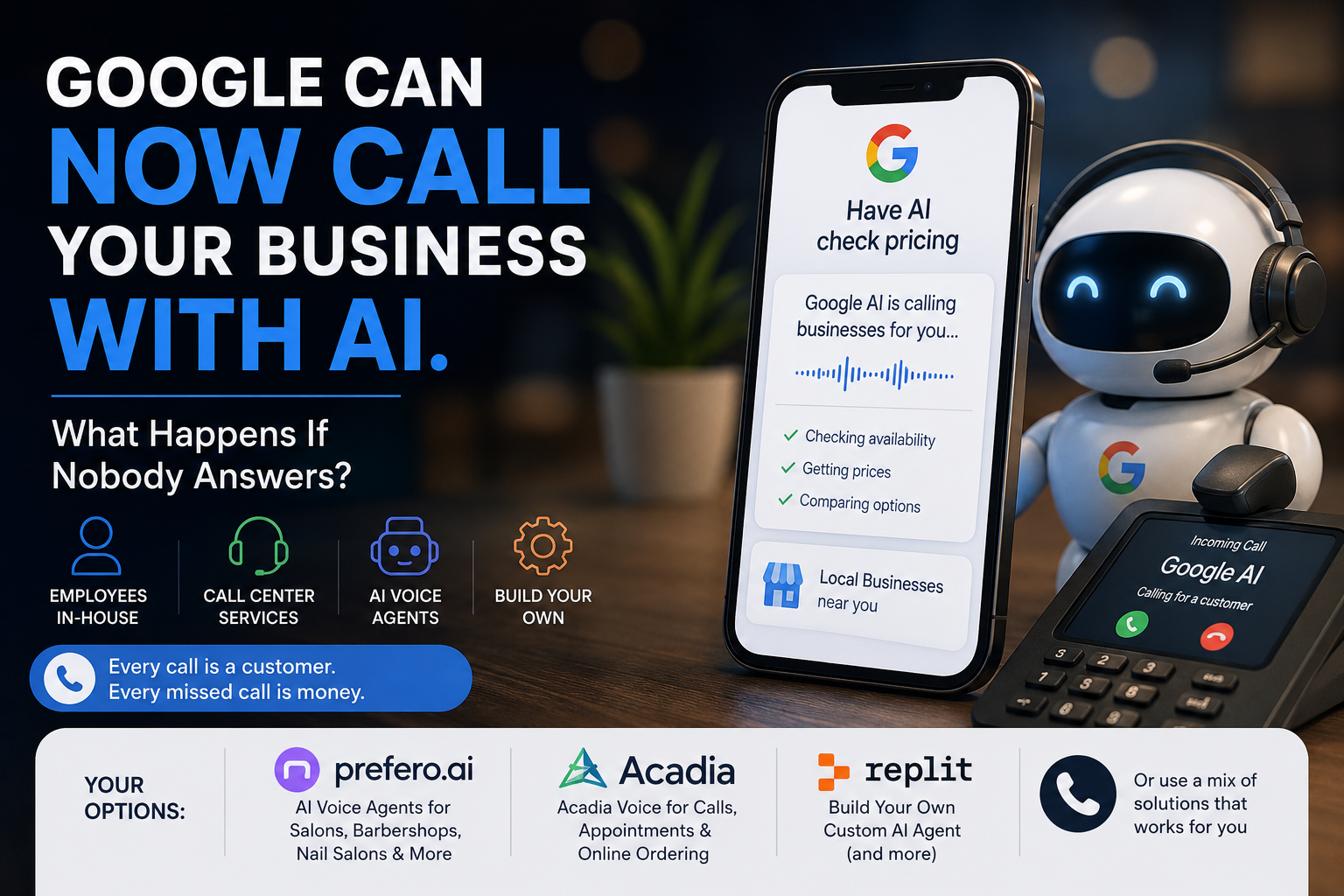
Google Search is changing what it means to get a lead.
For years, the process was straightforward.
Someone searched Google for a local business. They found a plumber, dentist, nail salon, barber, auto repair shop or pet groomer. Then they visited the business’s website or picked up the phone.
Now Google can pick up the phone for them.
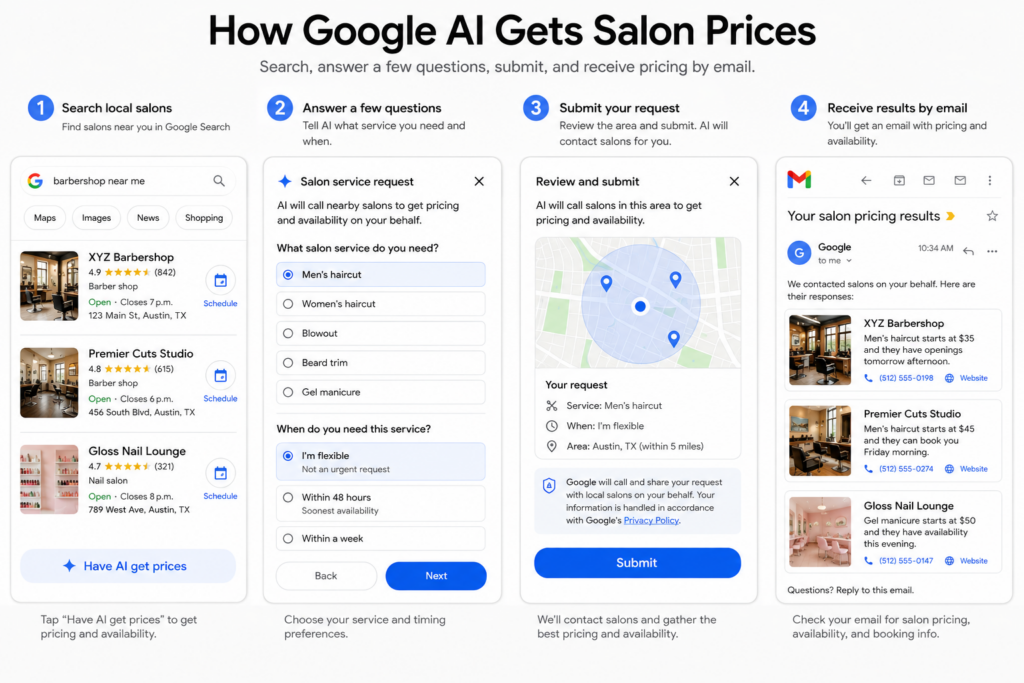
Google has introduced agentic AI features in Search that allow consumers to ask Google to contact multiple local businesses to check prices, availability and other information. A user may see a button such as “Have AI check pricing” when searching for certain local services. Google says Search can then contact businesses on the user’s behalf.
This creates an entirely new reason for local businesses to take phone answering seriously.
What Is Google’s “Have AI Check Pricing” Feature?
Suppose someone searches Google for:
“Pet groomers near me.”
Google may give that person the option to have AI check pricing.
The customer provides information about what they need and when they need it. Google can contact local businesses to gather pricing and availability information.
Google currently lists examples including hair salons, auto repair, pet grooming, wellness centers and other service categories, and the company says it continues to expand coverage.
This is different from a traditional Google search.
The customer may never personally call five businesses.
Google can make those calls for them.
Google Is Becoming Part of the Sales Process
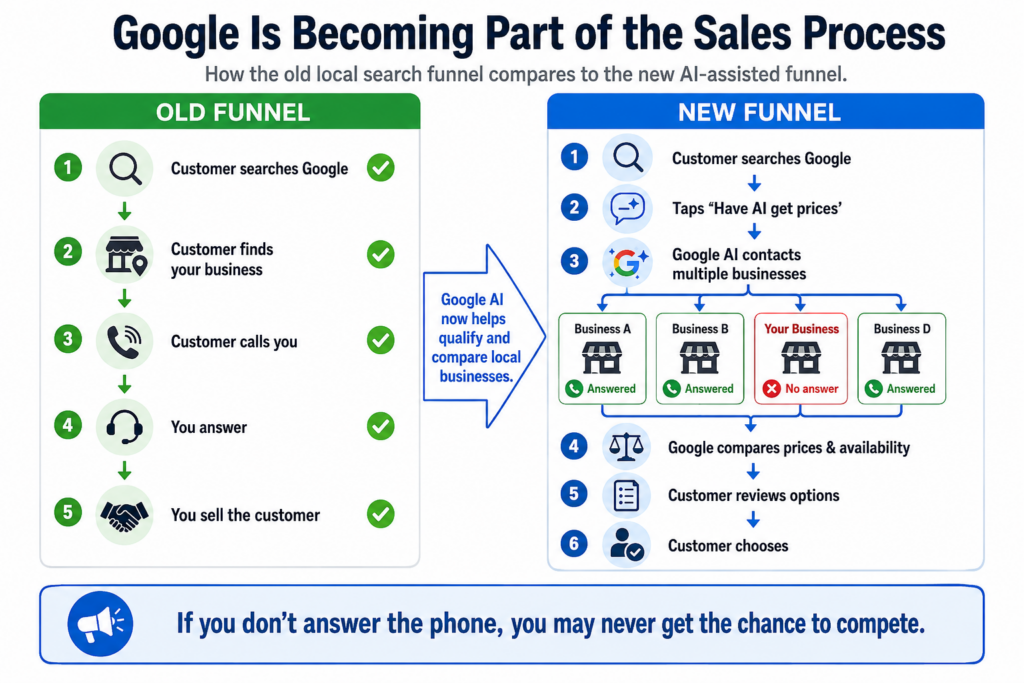
Think about the traditional local-search funnel:
Customer searches Google → Customer sees your business → Customer calls you → You answer → You sell the customer
The new process can look more like this:
Customer searches Google → Customer asks Google AI for help → Google contacts businesses → Google gathers information → Customer reviews the options
Google describes this capability as letting Search call businesses to collect pricing and availability without requiring the user to make the calls personally.
That changes the value of answering your phone.
If Google successfully reaches several competitors and gets useful pricing or availability information from them but cannot reach you, Google has less information to give the customer about your business.
That does not mean missing one of these calls directly hurts your Google ranking. Google has not stated that.
The problem is much simpler.
Your competitors answered. You didn’t.
What Happens When Nobody Answers?
Consider the commercial implications.
A customer might be ready to spend:
- $80 at a nail salon
- $200 at a barber or salon
- $300 on pet grooming
- $600 on emergency plumbing
- $2,000 on dental work
- $10,000 on an HVAC system
The exact numbers will obviously vary by business.
The point is that the customer may no longer be calling businesses one at a time.
An AI agent can increasingly do the initial research for them.
If nobody answers your phone, the opportunity can disappear before you even know it existed.
What If Someone Searches at Midnight?
This raises an interesting question.
Suppose someone searches Google at midnight:
“Best dentist near me with an appointment tomorrow.”
Or:
“Barber near me with availability tomorrow afternoon.”
Or:
“Nail salon that can do a full set tomorrow.”
They ask Google’s AI for help.
What happens next?
Does Google immediately call the business?
Does Google recognize that the business is closed and try later?
Does it gather whatever information it can online first?
Does it favor businesses from which it can obtain current information?
Google’s public documentation does not clearly spell out exactly how every after-hours scenario is handled.
Google does say AI Mode can gather information from the web, complete forms and call businesses directly when it needs specific pricing or availability information that is not available online.
So we would not tell a business owner that Google will definitely call their salon at 2:00 a.m.
We would tell them something more important:
Your customers do not operate according to your business hours.
People search at midnight.
They search Sunday morning.
They search while your receptionist is at lunch.
They search while your barber is cutting hair.
They search while your nail technician is working on a client.
They search while your plumber is underneath somebody’s sink.
The search can happen anytime.
Your business needs a strategy for what happens when the resulting phone call arrives.
The Phone Is Becoming Part of Your Digital Marketing Infrastructure
Businesses spend serious money getting discovered.
They pay for:
- Google Ads
- Local SEO
- Websites
- Social media
- Google Business Profile optimization
- Local Services Ads
- Directories
- Review generation
- Marketing agencies
Then the phone rings and nobody answers.
That was already expensive.
Agentic search makes it even harder to justify.
If you spend money getting your company found on Google but do not have a reliable system for handling the resulting calls, you have built a marketing funnel with a hole at the bottom.
You Do Not Need an AI Agent
We sell AI phone agents, but we want to be clear about something:
You do not have to buy an AI phone agent from us.
You need a reliable phone-answering strategy.
Those are two different things.
There are several ways to accomplish it.
Option 1: Have Employees Answer the Phone
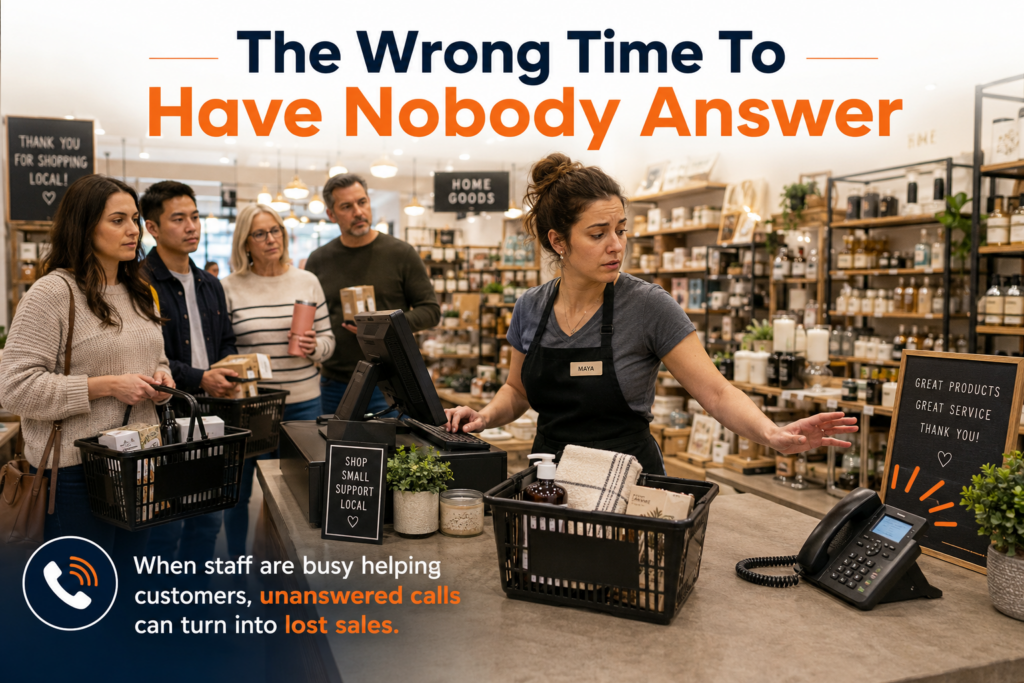
For many businesses, a trained employee remains the best option.
A good receptionist can answer detailed questions, build rapport, handle unusual situations and recognize when a customer needs human judgment.
The problem is coverage.
What happens:
- After hours?
- During lunch?
- When three people call simultaneously?
- When everyone is helping customers?
- On weekends?
- During holidays?
- When somebody calls in sick?
If your employees can reliably handle the call volume, great.
If they cannot, you need backup.
Option 2: Use a Human Answering Service or Call Center
Businesses have used answering services for decades.
A domestic or overseas call center can provide extended-hours coverage without requiring you to hire a complete internal reception team.
Quality varies significantly.
A generic operator who can only say, “I’ll have somebody call you back,” provides a very different experience from someone who understands your services, pricing, policies and availability.
The important part is that someone answers and gives the prospective customer useful information.
Option 3: Use an AI Phone Agent
AI phone agents can answer calls 24 hours a day without requiring someone to sit next to a telephone.
Depending on the platform and integrations, an AI agent can:
- Answer frequently asked questions
- Explain services
- Provide pricing or price ranges
- Check availability
- Schedule appointments
- Reschedule appointments
- Capture customer information
- Qualify leads
- Route calls
- Transfer complicated calls
- Provide directions and business hours
- Handle multiple calls simultaneously
Prefero.ai for Salons, Barbershops, Nail Salons and Beauty Businesses
For appointment-driven beauty and wellness businesses, Prefero.ai is one option worth looking at.
Prefero’s Cora AI receptionist handles customer inquiries across phone, text, WhatsApp, Instagram and web chat. Prefero says Cora can answer incoming calls 24/7, answer questions, check availability, book appointments and transfer urgent calls to the business.
That makes it particularly relevant for businesses such as:
- Barber shops
- Hair salons
- Nail salons
- Spas
- Med spas
- Beauty and wellness businesses
- Other appointment-driven service businesses
Prefero can adapt to the service menus and workflows of businesses such as barbershops and nail studios.
Prefero also offers local SEO and Google Business Profile optimization services, which connects directly with the problem we’re discussing here.
Getting your business discovered is step one.
Making sure somebody answers when that discovery turns into an inquiry is step two.
Option 4: Use Acadia Voice
Retail and Restaurant businesses using Acadia POS can also use Acadia Voice, which combines business phone functionality with AI and POS integration.
Acadia voice technology can speak directly with customers, take orders over the phone and send those orders directly into the POS receipt or kitchen printer in real time.
This creates a particularly useful scenario for businesses that accept food or product orders.
Instead of:
Customer calls → Employee answers → Employee manually enters order
the workflow can become:
Customer calls → Acadia Voice answers → Customer places order → Order goes into the POS
Acadia also offers integrated appointment scheduling. Its scheduling platform supports online booking, with reservations flowing directly into the employee booking calendar.
That means businesses using the appropriate Acadia setup can create workflows where customers can:
- Call and ask questions
- Place orders by phone
- Have phone orders sent into the POS
- Book appointments
- Use online scheduling
- Manage reservations inside the same business ecosystem
For a restaurant, retail business, salon or other operation already using Acadia, connecting the phone conversation directly to the POS can provide significantly more value than an answering service that simply takes a message.
Option 5: Build Your Own Custom AI Agent
Some businesses have needs that do not fit into an off-the-shelf system.
Maybe your calls involve:
- Complicated qualification
- Technical products
- Detailed pricing rules
- Large knowledge bases
- Multiple locations
- Specialized documentation
- Internal policies
- CRM integrations
- Complex escalation procedures
- Industry-specific terminology
- Custom workflows
- Unique compliance requirements
In that case, you can build something more specialized.
One increasingly accessible approach is to use an AI development platform such as Replit or a similar AI application-building platform.
Replit Agent allows users to describe an application or AI agent in natural language and have the platform build the underlying application, integrations and workflows. Replit specifically markets the ability to create AI agents without requiring traditional coding experience.
For example, you could develop a custom system that knows:
- Your complete service catalog
- Pricing rules
- Employee schedules
- Frequently asked questions
- Product documentation
- Service territories
- Qualification requirements
- Customer history
- CRM data
- Escalation procedures
- Appointment rules
You could then connect that application to the appropriate voice, telephony, AI model, CRM, booking system or other APIs required for your business.
This option gives you substantially more flexibility.
It also gives you substantially more responsibility.
Building the application is only part of the job.
A production phone agent also needs reliable telephony, speech recognition, voice generation, integrations, error handling, security, monitoring, testing and escalation procedures.
So there are really two ways to approach a custom agent.
Build It Yourself
Use Replit or another AI development platform, combine it with the necessary voice and telephony services, and create the workflows yourself.
This makes sense if you have technical resources or enjoy building and maintaining systems.
Have Someone Build It for You
We also resell and implement more customizable third-party agentic AI solutions for businesses whose requirements go beyond what Prefero.ai or Acadia Voice are designed to handle.
These systems can be trained around:
- Company documents
- Product catalogs
- Knowledge bases
- Standard operating procedures
- Pricing structures
- Sales scripts
- Technical documentation
- Customer qualification rules
- Company policies
- Internal workflows
The goal is not simply to create an AI that talks.
The goal is to create an agent that understands enough about your business to provide useful, consistent and accurate responses when somebody calls.
Option 6: Use a Hybrid
You do not have to choose humans or AI.
For many businesses, the best setup will combine several options.
For example:
During business hours:
Your receptionist answers first.
When employees are busy:
The AI agent picks up instead of sending callers to voicemail.
After hours:
The AI answers questions, captures leads, takes eligible orders or books appointments.
Complicated situations:
The AI transfers the caller to a person or creates a detailed follow-up task.
This allows employees to handle the conversations where human judgment provides the most value while automation handles calls that otherwise might have gone unanswered.
Train Your Staff and Your AI for AI Callers
There is another change businesses need to consider.
The person calling your business may not be a person.
Google says Search can call businesses on behalf of users to collect specific information such as pricing and availability.
Your employees need to understand that these calls can represent real customer demand.
Imagine this:
Google’s AI:
“I’m calling on behalf of a customer looking for a haircut tomorrow afternoon. What is your price for a men’s haircut, and do you have availability?”
Employee:
“We don’t talk to robots.”
Click.
That employee may have just hung up on an inquiry being made for a real prospective customer.
Your AI phone agent should understand these interactions too.
We are entering a world where an AI representing a customer may talk directly to an AI representing a business:
Customer → Google AI → Your AI phone agent → Your booking system → Appointment
Or:
Customer → Google AI → Your AI phone agent → Your POS → Order
Machine-to-machine customer acquisition is no longer a theoretical concept.
Google has already started making the calls.
Keep Your Google Business Profile Accurate
Phone answering is only part of the equation.
Your Google Business Profile should accurately reflect information such as:
- Business hours
- Phone number
- Services
- Service area
- Website
- Appointment links
- Business category
- Holiday hours
Google says AI Mode can gather information from across the web and contact businesses when it needs specific information that is not readily available online.
The easier it is for Google to understand your business, the better positioned you are to participate in this new type of customer journey.
That also makes SEO increasingly important.
Answering an AI-generated inquiry does not matter if your company never gets discovered in the first place.
Test Your Own Business
Business owners should run a simple test.
Open up private browsing window.
Search Google for the services you sell.
Try:
“[Your service] near me”
“Best [your service] near me”
“[Your service] prices near me”
“[Your service] available today”
Look at what Google displays.
Look at your competitors.
Check your Google Business Profile.
Then call your own business.
Call during the day.
Call during lunch.
Call after hours.
Call on Saturday.
Let it ring.
See what happens.
Ask yourself one question:
If I were a customer ready to spend money, would this experience convince me to continue?
Every Business Needs a Phone Answering Strategy Now
Google’s AI calling capabilities do not mean every business needs to immediately buy an AI receptionist.
They mean something broader.
Every business needs to decide what happens when the phone rings and nobody is available to answer it.
Your options include:
- Have employees answer.
- Hire a human answering service or call center.
- Deploy an AI phone agent such as Prefero.ai.
- Use an integrated platform such as Acadia Voice.
- Build a custom solution yourself with tools such as Replit.
- Have us implement a specialized third-party AI agent.
- Combine several approaches.
Use whatever works for your business.
The technology is secondary.
Answering the opportunity is what matters.
“We’ll call them back tomorrow” becomes increasingly dangerous when technology can contact several competing businesses in a fraction of the time it once took a customer to research them manually.
Google is changing the equation.
The unanswered phone call is no longer simply a missed call.
It may represent a customer whose AI assistant is actively trying to compare your company with competitors that did answer.
And you may never know the opportunity existed.
Need Help Building a 24/7 Phone Strategy?
Different businesses need different levels of automation.
For barber shops, hair salons, nail salons, spas and other appointment-driven beauty businesses, explore Prefero.ai for AI-powered phone answering, booking and local SEO.
Businesses using Acadia can explore Acadia Voice for AI-assisted phone answering and phone ordering connected to the Acadia POS ecosystem.
Businesses that want to experiment with building their own custom AI application can explore Replit and similar AI development platforms.
And businesses with more complicated requirements can work with us to implement a specialized AI phone agent trained around their documents, services, workflows, policies and customer questions.
Or do not use AI at all.
Hire somebody.
Use a call center.
Build your own.
Use a hybrid.
Just make sure somebody, or something, answers the phone.