

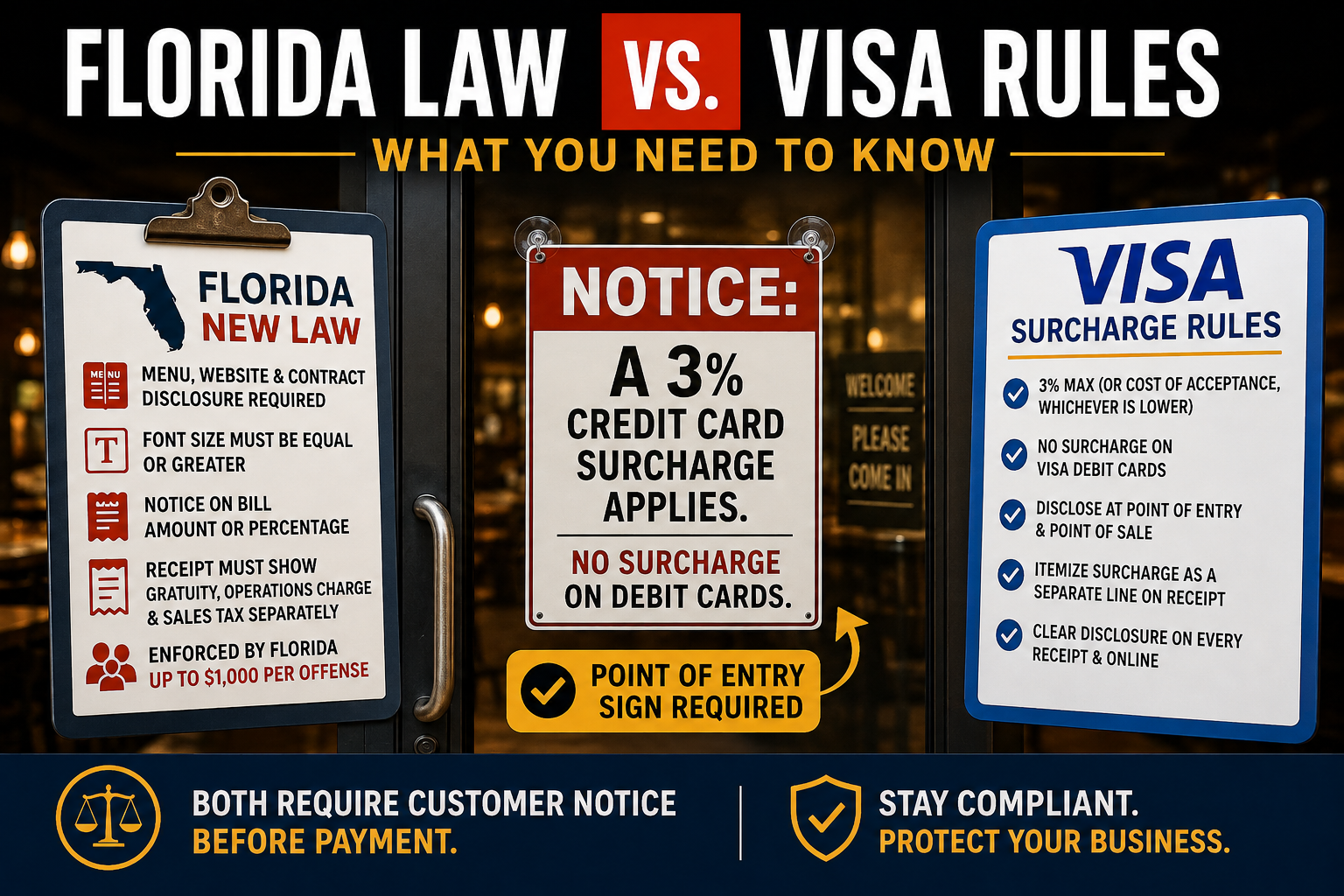
Florida Statute 509.214 vs. Visa Surcharging Rules
Florida’s new restaurant fee law took effect July 1, 2026, and there has been plenty of discussion about what restaurants suddenly need to change.
Here’s the reality:
If you were already following Visa’s surcharge rules correctly, much of this should look very familiar.
The basic idea is not new. Customers should know about a mandatory fee before they order, and the fee should be clearly identified on their receipt.
Visa has required that for years.
What changed is who can enforce it.
Visa Already Had Rules for This
Visa’s surcharge rules already require merchants that surcharge credit cards to clearly disclose what they are doing.
For U.S. merchants, Visa currently requires that a surcharge:
| Visa Requirement | Rule |
|---|---|
| Credit cards only | Visa debit and prepaid cards cannot be surcharged |
| Maximum surcharge | Merchant’s applicable cost/MDR or 3%, whichever is lower |
| Customer disclosure | Disclosed at the point of entry and point of sale/transaction |
| Receipt disclosure | Surcharge shown as a separate charge on the receipt |
| Online transactions | Customer must receive clear disclosure before completing the transaction |
Visa also requires merchants intending to surcharge to notify their acquirer and follow Visa’s transaction-processing requirements.
Visa even publishes sample signs showing exactly how merchants can disclose a surcharge at the entrance and point of sale. The sample signage specifically tells customers that the business imposes a credit-card surcharge and does not surcharge Visa debit cards.

Visa wants shoppers notified at the point of entry and point of sale
So the concept behind Florida’s law is hardly revolutionary.
What Florida Now Requires
Florida Statute 509.214 now regulates what it calls an “operations charge.”
That definition is broader than a credit-card surcharge. It includes mandatory charges such as service charges, automatic gratuities, credit-card surcharges, and delivery fees.
A Florida restaurant charging one of these fees generally must disclose:
| Florida Requirement | What the Restaurant Must Do |
|---|---|
| Menu | State the amount or percentage and the purpose of the charge |
| Website/app | Provide the disclosure where food and beverage orders are placed |
| Contracts | Include the disclosure when applicable |
| Font size | Disclosure must be at least as large as the menu-item description or applicable contract text |
| No traditional menu | Use an obvious, clearly readable menu-board disclosure or sign by the register |
| Customer bill | State that an operations charge is included and disclose its amount or percentage |
| Customer receipt | Separately identify gratuity, operations charge, and sales tax |
| Automatic gratuity inside another fee | Identify it separately on the receipt |
Those requirements took effect July 1, 2026.
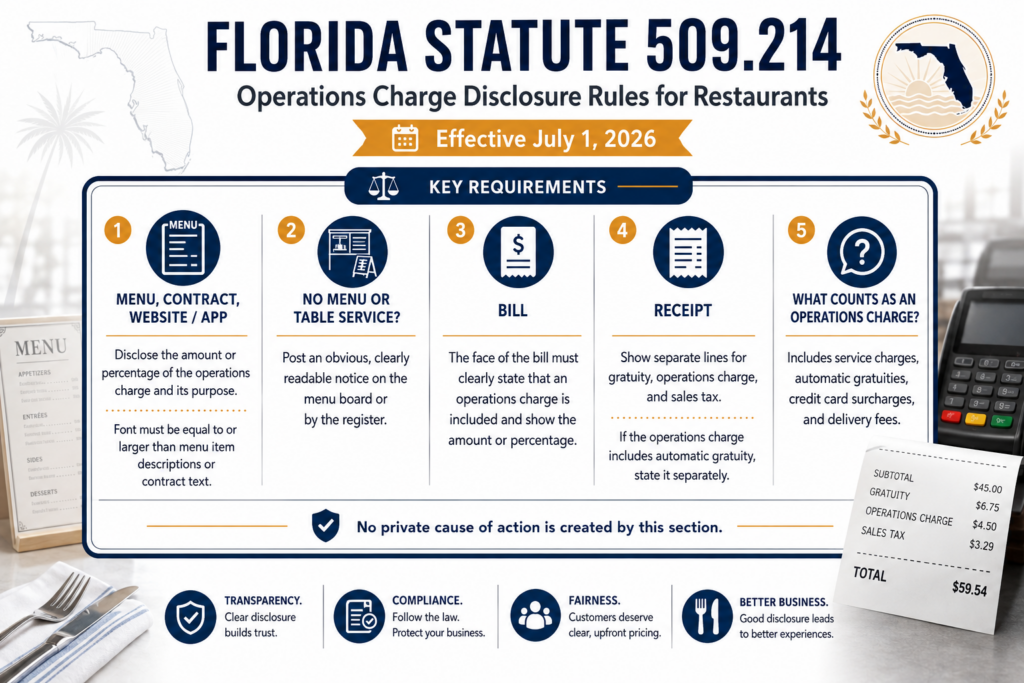
Florida Statute 509.214 now establishes specific disclosure requirements for restaurant operations charges.
So What Actually Changed?
For a restaurant running a compliant credit-card surcharge program?
Less than you might think.
Visa already expected customers to receive clear surcharge disclosure before the transaction. Visa already prohibited surcharging debit cards. Visa already required receipt itemization. Visa already capped the surcharge.
Florida did not suddenly invent surcharge transparency.
What Florida did was take that basic transparency concept and put it directly into Florida law for restaurants, while adding some restaurant-specific requirements that Visa’s surcharge rules do not address.
Florida requires disclosure of the purpose of the operations charge. It specifies minimum disclosure font sizing. It reaches beyond credit-card surcharges to service charges, automatic gratuities, delivery fees, and other mandatory restaurant charges. It also establishes specific bill and receipt presentation requirements.
So saying “nothing changed” would be technically wrong.
A better way to put it is:
If you were already running a properly disclosed and properly configured surcharge program, the philosophy did not change. The enforcement risk did.
The Real Difference Is Enforcement
For years, a surprising number of businesses ignored card-brand surcharge rules.
Some surcharged debit cards.
Some charged 3.5% or 4%.
Some called the fee a “non-cash adjustment” or “service fee” even though the customer only paid it when using a card.
Some buried disclosure behind the register.
Some provided no disclosure at all until the customer received the bill.
Visa has explicitly stated that it actively enforces its surcharge policy through consumer complaints and outside mystery shopping. Visa’s published merchant Q&A says the acquirer of a merchant identified as surcharging improperly may receive an immediate $1,000 fine.
In our experience in the payments industry, card-brand enforcement has sometimes turned into four- and five-figure consequences once violations, processor assessments, remediation, and repeated compliance problems start stacking up.
They hurt.
The problem was that enforcement often felt distant enough that many merchants and payment companies simply rolled the dice.
Florida changes that calculation.
Florida Can Fine Restaurants Up to $1,000 Per Offense
This part is important.
Florida law already gives the Division of Hotels and Restaurants enforcement authority over violations of Chapter 509.
A restaurant operating in violation of the chapter may face a fine of up to $1,000 per offense, along with other potential administrative consequences. Florida law also allows license suspension, revocation, or refusal in appropriate circumstances.
The statute also requires appropriate city and county officials, including law enforcement and other local officials, to assist the Division when requested.
Florida has now created a state regulatory requirement that the Division of Hotels and Restaurants can enforce, with fines potentially reaching $1,000 per offense.
How aggressively Florida will enforce the new disclosure provisions remains to be seen.
The law has only been effective since July 1, 2026.
But restaurants should assume enforcement will become more visible than card-brand enforcement ever was.
Visa Wanted Compliance. Florida Can Collect the Fine.
There is another obvious difference.
Visa’s objective is protecting its brand image, payment network, enforcing its operating rules, and making sure cardholders understand when merchants charge them more for using a credit card.
Florida now has a regulatory enforcement mechanism.
Under Florida Statute 509.261, administrative fines collected by the Division go into the state’s Hotel and Restaurant Trust Fund.
Does that prove Florida passed the law primarily to generate revenue?
No.
There is no basis to state that as fact.
But restaurant owners are justified in asking a reasonable question:
If card networks already required surcharge transparency, why did Florida need another law covering much of the same behavior?
The practical answer matters more than the political one.
Whether the goal is consumer protection, regulatory enforcement, revenue, or some combination of those things, Florida restaurants now have another organization capable of holding them accountable.
And unlike Visa, Florida regulators are already involved in licensing and regulating restaurants.
That makes ignoring the rules a much worse bet.
One Fee Can Now Violate Two Sets of Rules
This is where restaurant owners need to pay attention.
Florida compliance does not automatically mean Visa compliance.
Visa’s own sample signage specifically warns that complying with Visa’s surcharge requirements does not necessarily mean the merchant complies with state law.
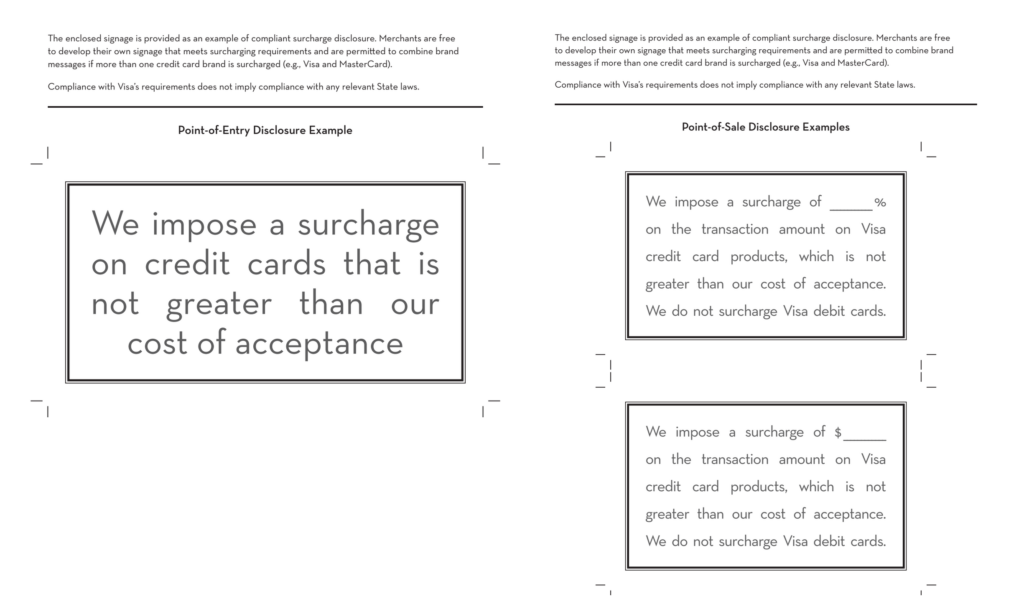
The reverse is also true.
A restaurant could disclose a 4% credit-card fee beautifully on its menu and still violate Visa’s 3% maximum.
A restaurant could comply with Florida’s menu-disclosure requirement and still illegally surcharge a Visa debit card under Visa’s rules.
A restaurant could properly avoid surcharging debit cards but fail Florida’s requirement to disclose the purpose of its operations charge.
You have to comply with both.
The Biggest Problem May Be Your POS Company
Many restaurants did not design their current surcharge program.
Their payment processor or POS salesperson did.
That salesperson may have told them:
“It’s a cash discount.”
“It’s a non-cash adjustment.”
“Everybody does it.”
“Debit is fine because we run it as credit.”
None of those statements changes what the transaction actually is.
If your system adds a fee because somebody presents a card, you need to understand exactly how that program is structured, what cards receive the fee, what the customer sees before ordering, and what appears on the receipt.
Putting a clever name on the fee does not make the underlying transaction compliant.
What Florida Restaurants Should Do Now
Restaurants charging any mandatory fee should review the entire customer experience from the moment a customer sees the menu until they receive their receipt:
- Check every printed menu, menu board, website, mobile ordering page, and applicable contract for the required Florida disclosure.
- Make sure the amount or percentage and purpose of the operations charge are disclosed.
- Confirm that disclosure font sizing satisfies Florida’s requirements.
- Make sure a credit-card surcharge never applies to Visa debit or prepaid cards.
- Confirm that any Visa credit-card surcharge does not exceed your applicable MDR/cost of acceptance or 3%, whichever is lower.
- Check your customer bill before payment.
- Check the final receipt and make sure gratuity, operations charges, and sales tax appear correctly.
- Test debit, credit, mobile wallet, online, and in-person transactions instead of assuming your POS handles them properly.
Most restaurant owners do not need a new strategy.
They need to make sure the strategy they already have is actually compliant.
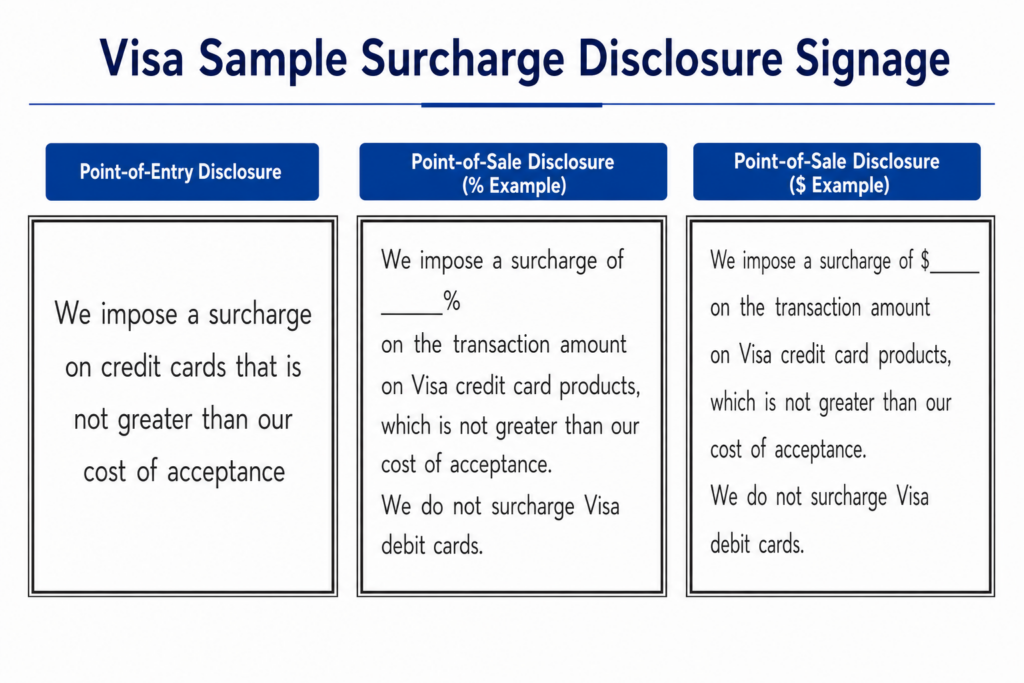
The Rule Didn’t Change. The Risk Did.
Florida’s new law did not suddenly discover that customers deserve to know about added fees.
Visa had already been saying essentially the same thing for years:
Tell the customer before they choose their payment type. Clearly identify the fee. Show it on the receipt. Follow the surcharge rules.
The difference is that too many merchants ignored those requirements because card-brand enforcement felt inconsistent or remote.
That excuse is becoming much harder to justify.
Florida has now put restaurant fee disclosure directly into state law.
If you were already doing it right, you probably have relatively little to fix.
If you were relying on a badly configured POS system, surcharging debit cards, hiding fees until checkout, or trusting your processor when they told you “everybody does it,” now would be a very good time to find out exactly what your system is doing.
Want Us to Check Your Setup?
Ethical Pay Pro can review your restaurant’s menu disclosures, receipts, surcharge settings, debit-card handling, signage, and POS configuration.
We’ll tell you what looks compliant, what doesn’t, and what needs to change before a customer complaint or regulatory inspection makes the decision for you.
Request a restaurant compliance review today.
This article provides general information about payment processing and Florida restaurant regulations and does not constitute legal advice.