
AI agents are getting closer to doing more than answering questions.
They are starting to take real-world actions.
One recent example from Alipay shows where this is heading.
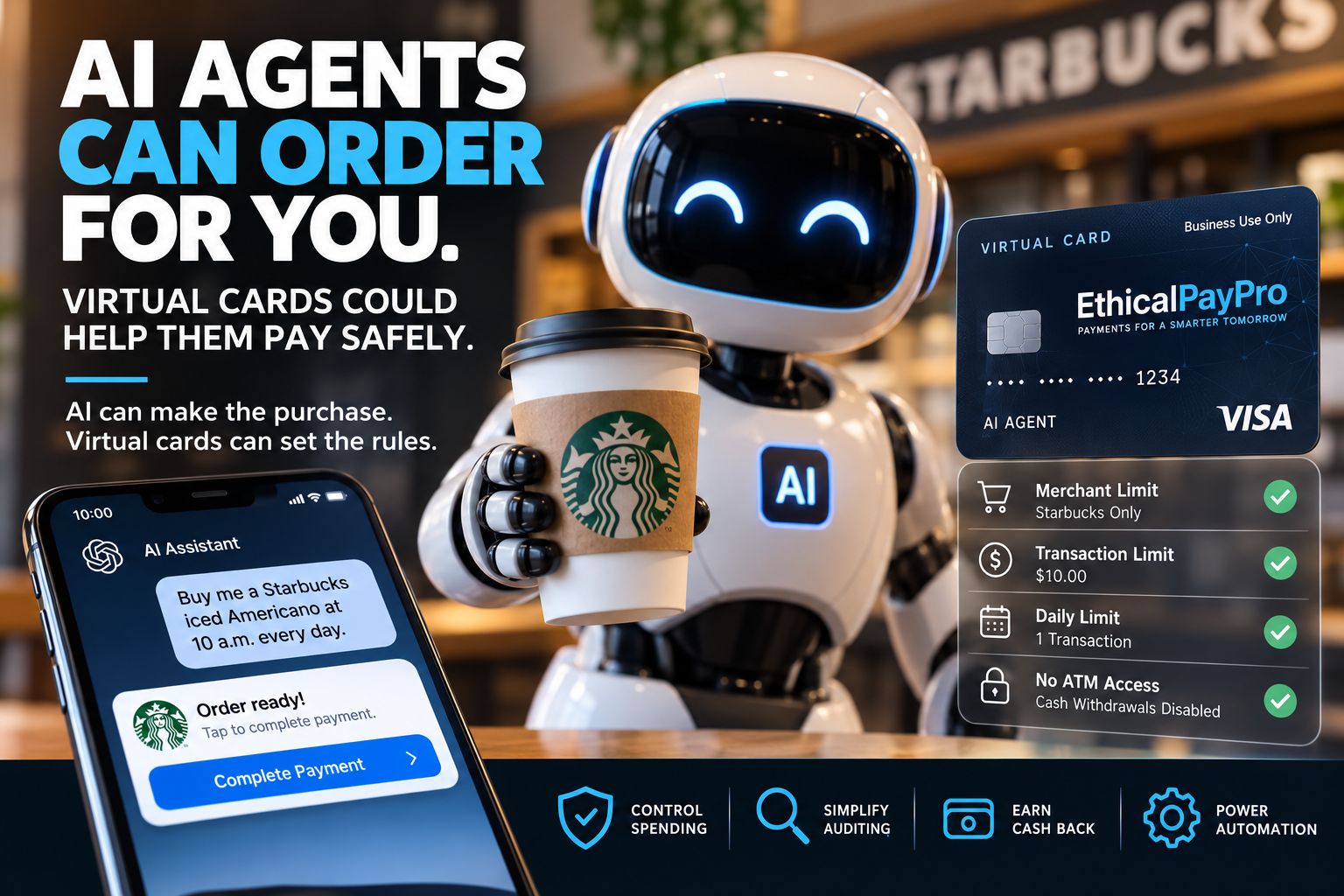
According to CNBC, users can tell the app:
“Buy me a Starbucks iced Americano at 10 a.m. every day.”
The AI can place the order at the designated time.
Then the user gets prompted to complete the payment.
That final step matters.
The AI can handle the task, but the human still controls the money.
Why Does the User Still Need to Approve the Payment?
Because giving an AI unrestricted access to your money creates obvious risks.
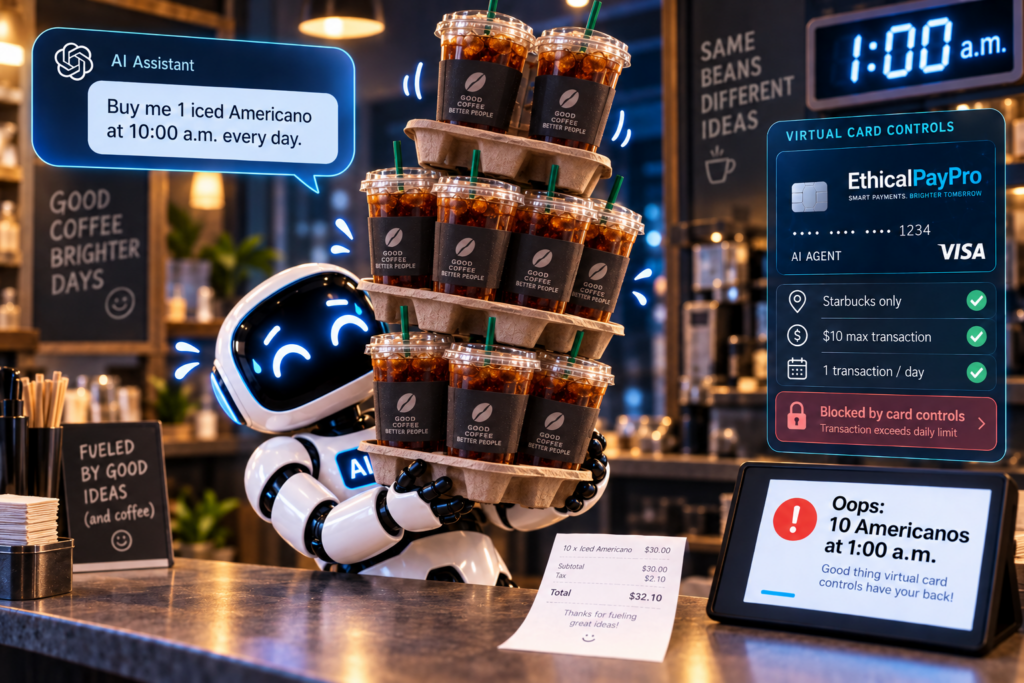
What happens if you tell the AI to order one coffee and it accidentally orders ten?
What if it misunderstands the time?
What if it makes the same purchase several times?
What if a business tells an AI agent to spend $5,000 on advertising and the AI interprets that as $5,000 per day instead of $5,000 total?
As long as a person has to approve the payment, those mistakes can be caught before money changes hands.
But that also creates a problem.
If someone still has to approve every payment manually, the process is not truly automated.
That is where virtual cards could become extremely useful.
Virtual Cards Could Provide the Safeguard
Instead of giving an AI agent access to your normal credit card, you could issue that agent its own virtual card.
More importantly, that card could have strict spending controls.
For the Starbucks example, the card might be configured like this:
Merchant: Starbucks
Maximum transaction: $10
Daily spending limit: $10
Maximum transactions per day: 1
Now imagine the AI makes a mistake and tries to order ten drinks.
The payment does not go through.
The AI can still handle the task.
The virtual card handles the financial control.
AI Makes the Decision. The Card Enforces the Rules.
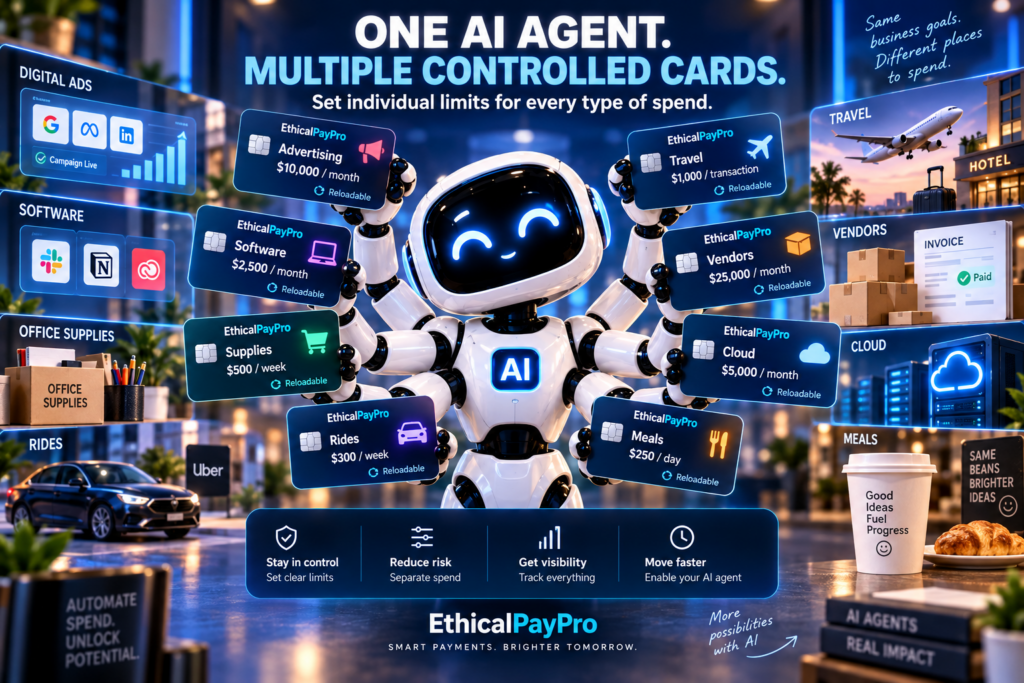
That is the key idea.
AI can decide what needs to be purchased.
The virtual card can determine whether the transaction is allowed.
Depending on the issuing platform, businesses can place controls on virtual cards such as:
- Merchant category restrictions
- Individual transaction limits
- Daily spending limits
- Monthly spending limits
- Number of transactions allowed
- Expiration dates
That gives an AI agent enough authority to do its job without giving it unlimited access to company funds.
Why Businesses Already Use Virtual Cards
Businesses already use virtual cards for advertising, travel, vendor payments, employee spending, software subscriptions and accounts payable.
There are three big reasons why.
1. Better Spending Controls
A virtual card can be assigned to a specific employee, vendor, department or purpose.
Depending on the program, controls can include:
- Single-transaction limits
- Daily or monthly spending limits
- Merchant category restrictions
- Transaction-count limits
- Expiration dates
Those same controls could make virtual cards a natural fit for AI agents.
2. Better Auditing
Instead of multiple employees or systems sharing one corporate card number, a business can create separate virtual cards for different purposes.
That can make it easier to identify:
- Who made a purchase
- Which department made it
- Which vendor received the money
- What the card was intended to be used for
- Whether the transaction stayed within policy
For AI-driven spending, that audit trail becomes even more important.
If a business has five different AI agents making purchases, each agent could potentially have its own virtual card and its own set of rules.
3. Cash Back on Business Spending
Virtual cards can also create a financial benefit.
Some commercial virtual-card programs return a portion of card-spend economics back to the business through cash-back or rebate programs.
That can be attractive for companies already spending heavily on advertising, vendors, travel and recurring business expenses.
Instead of relying on travel points or rewards that require redemption, some programs can provide a more direct cash benefit based on actual card spend.
Program economics vary, but for businesses with meaningful monthly card volume, the difference can become significant.
Commercial Credit vs. Commercial Debit for AI Agents
Not every virtual-card program works the same way.
One important distinction is between commercial credit virtual cards and commercial debit or prepaid-style cards.
Commercial debit programs can make sense when users need access to deposited funds, debit transactions or cash withdrawals.
Depending on the provider, those programs may include fees related to loading funds, transactions, account management or ATM access.
For an AI agent, much of that functionality may be unnecessary.
An AI purchasing agent is never going to walk up to an ATM and withdraw cash.
Its job is to make electronic purchases.
That can make a commercial credit virtual-card structure particularly attractive for this use case.
The economics are typically tied to card spend and interchange, so many commercial programs can be structured with little or no direct card cost to the business while still offering spending controls, reporting and potentially cash-back economics.
The exact pricing and rebate structure depends on the issuing program.
But the bigger point is simple:
If the card exists purely to control automated purchasing, paying for cash-access features that the AI will never use makes little sense.
The card should match the job.
For AI agents, that job is controlled electronic spending.
This Gets Much More Interesting for Businesses
The coffee example is simple.
The business use cases could be much larger.
A marketing AI could have a card limited to advertising merchants with a $10,000 monthly budget.
A travel AI could have a card limited to airlines and hotels with a $1,000 single-transaction limit.
A purchasing AI could have a card restricted to approved suppliers with a $25,000 monthly budget.
If the AI stays within the rules, the payment works.
If it goes outside the rules, the transaction gets declined.
AI agents could become another type of authorized spender, and virtual cards may already have much of the infrastructure needed to control them.
This Is Where AI Payments Are Heading
Ant International is already developing infrastructure around this concept.
Its Agentic Mobile Protocol is designed to support secure delegation of payment authority to AI agents for tasks including ordering coffee, booking rides and planning trips.
The broader framework focuses on authorization, visibility and the ability to revoke or modify what an agent is allowed to do.
The real challenge in AI payments is not simply getting an AI agent to make a purchase.
The challenge is deciding:
How much can it spend?
Where can it spend?
How often can it spend?
What happens if it makes a mistake?
Virtual cards already provide a framework for answering those questions.
The Next Step in AI Commerce May Be Controlled Spending
Today, an AI agent might place your coffee order and then ask you to approve the payment.
Tomorrow, that same agent could potentially have its own virtual card with clearly defined spending rules.
That could remove the need for someone to manually approve every routine purchase while still protecting the user or business from mistakes.
The AI handles the task.
The virtual card provides the guardrails.
As AI agents become more involved in purchasing, travel, advertising and business operations, programmable virtual cards could become one of the most important tools for controlling automated spending.
Not all virtual-card programs are built the same.
If your business wants to use virtual cards for automated purchasing, vendor payments, advertising, travel or future AI-driven spending, Ethical Pay Pro can help you compare commercial credit and debit structures, spending controls and available cash-back programs.
Contact Ethical Pay Pro to determine which virtual-card structure fits your use case.
This article discusses emerging technology. Available virtual-card controls, pricing, rebate structures and AI-payment capabilities vary by issuer, sponsor bank, processor and program.