

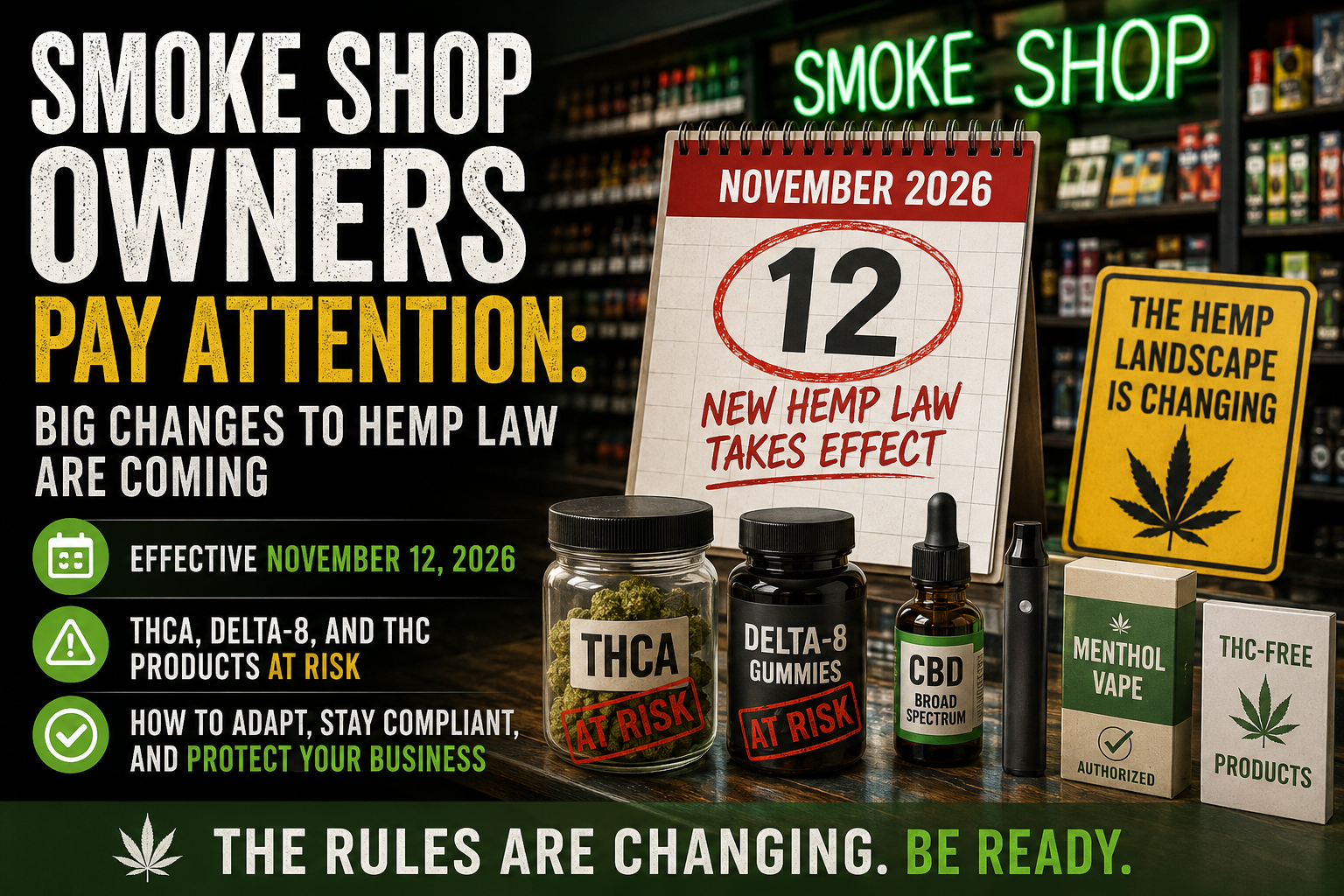
If you own a smoke shop in Florida, November 2026 is a date you should have circled on your calendar.
The federal government is changing the definition of legal hemp, and the change could wipe out a large portion of the intoxicating hemp products that have become major revenue generators for smoke shops over the last several years.
That means THCA flower, Delta-8, many Delta-9 gummies, THC drinks and other intoxicating hemp products could disappear from ordinary smoke shop shelves.
And if you’ve noticed more smoke shops being offered for sale, the timing makes sense.
What Happened?
The story starts with the 2018 Farm Bill.
Congress legalized hemp by defining it primarily around one number: cannabis containing no more than 0.3% Delta-9 THC by dry weight.
The problem was that the definition left room for products Congress probably never envisioned.
Companies began selling Delta-8, THCA flower, hemp-derived Delta-9 gummies and other intoxicating products while arguing that they still qualified as legal hemp under the 2018 definition.
It became known as the Farm Bill loophole.
For smoke shops, it created an entirely new product category.
For regulators, it created a market where products capable of getting customers high could sometimes be purchased outside licensed marijuana dispensaries.
Congress has now rewritten the definition.
What Changes in November 2026?
Under the federal law signed in November 2025, the new hemp definition is scheduled to take effect November 12, 2026.
Instead of looking primarily at Delta-9 THC, the new definition looks at total THC, including THCA, and places major restrictions on manufactured intoxicating cannabinoids.
There is also a huge change for finished products.
A final hemp-derived cannabinoid product containing more than 0.4 milligrams of combined total THC and THC-like cannabinoids per container can fall outside the new federal hemp definition.
Put that into perspective.
A package containing twenty 10mg THC gummies contains 200mg of THC.
The new threshold is 0.4mg for the entire container.
That isn’t a small adjustment.
It completely changes the business model.
What Products Are Most at Risk?
For the average smoke shop, the categories to watch include:
- THCA flower
- Delta-8 products
- Delta-10 products
- Hemp-derived intoxicating Delta-9 gummies
- THC beverages
- Converted or manufactured intoxicating cannabinoids
- Many full-spectrum CBD products containing measurable THC
Products that no longer qualify as hemp could become subject to federal controlled-substance laws instead.
That is why smoke shop owners should take this seriously rather than assuming manufacturers will simply change the labels.
What About CBD?
CBD isn’t necessarily going away, but smoke shop owners need to understand the difference between full-spectrum and broad-spectrum products.
Full-spectrum CBD normally contains CBD along with other naturally occurring cannabinoids, including small amounts of THC.
Broad-spectrum CBD generally attempts to retain CBD and other hemp compounds while removing THC.
With a federal limit as low as 0.4mg per finished container, many traditional full-spectrum products may have a problem.
That could make properly manufactured and independently tested broad-spectrum and CBD isolate products much more important.
But don’t simply trust a bottle that says “THC Free.”
Ask your distributor for current Certificates of Analysis and understand exactly what you’re putting on your shelves.
The Vape Side Isn’t Getting Easier Either
THC isn’t the only issue.
Smoke shops also need to look carefully at their nicotine vape inventory.
FDA currently lists 45 authorized e-cigarettes as lawful for sale in the United States. Most of the authorized market has historically centered around tobacco and menthol products, although FDA authorized its first non-tobacco, non-menthol e-cigarette flavors in May 2026.
That means the future smoke shop could look very different from the store customers see today.
The colorful wall of disposable vapes and the display case filled with THCA, Delta-8 and THC gummies may become much harder to operate legally.
So Why Would Someone Sell Their Smoke Shop Now?
This comes down to valuation.
Imagine a smoke shop doing $1 million per year in sales.
That sounds great.
But what if $400,000 of that revenue comes from THCA flower, Delta-8 vapes and intoxicating hemp gummies?
A buyer doesn’t care what the store did last year.
The buyer cares what the store can legally sell next year.
If a major percentage of revenue disappears, the business could suddenly be worth substantially less.
That creates a simple incentive for some owners:
Sell before the numbers change.
It doesn’t prove that every Florida smoke shop listing is connected to the hemp law. Owners sell businesses for dozens of reasons. But the regulatory uncertainty certainly gives owners and buyers something new to think about.
What If You Can’t Sell or Walk Away?
This may be the bigger question.
A lot of smoke shop owners are sitting inside three-year, five-year or even longer commercial leases.
Closing the doors doesn’t make the rent disappear.
So instead of waiting until November, owners should start thinking about what the next version of their store looks like.
Possible categories worth researching include:
- Properly tested broad-spectrum CBD products
- CBD isolate products
- Non-intoxicating hemp topicals
- Hemp clothing and apparel
- Hemp bags, accessories and fiber products
- Legal smoking accessories
- FDA-authorized vaping products
- Cigars and other lawful tobacco products
- Authorized nicotine alternatives
- Other conventional convenience and lifestyle products that fit the customer base
There may still be a legitimate hemp industry after November.
It just might look a lot more like the hemp industry Congress originally imagined and a lot less like an unlicensed marijuana dispensary.
One warning: don’t replace one compliance problem with another.
A CBD cream might be a product your customers love, but marketing it as something that “cures fibromyalgia,” treats arthritis or cures another disease can create a separate FDA issue. FDA has specifically taken enforcement action against companies making disease-treatment claims for unapproved CBD products.
Find reputable suppliers. Demand testing. Be careful with health claims.
The November Twist
There is one final wrinkle.
As of August 8, 2026, the U.S. Senate has passed a funding bill that would temporarily delay much of the upcoming hemp change until December 11, 2026.
But that delay is not law yet. The House and Senate still have differences to resolve before anything reaches the President.
So smoke shop owners shouldn’t build a business plan around Congress rescuing them.
Plan around November 12 until the law actually changes.
Because when the dust settles, the traditional Florida smoke shop may be left with a much narrower selection of federally lawful nicotine products, THC-free or extremely low-THC hemp products, CBD products that actually meet the rules, tobacco, accessories and whatever new categories smart operators develop.
The owners who start adjusting their inventory now have options.
The owners who wait until November may discover that half their store became obsolete overnight.
This article is for general informational purposes and is not legal advice. Hemp, tobacco and cannabinoid laws can change quickly and may differ by state and locality.