

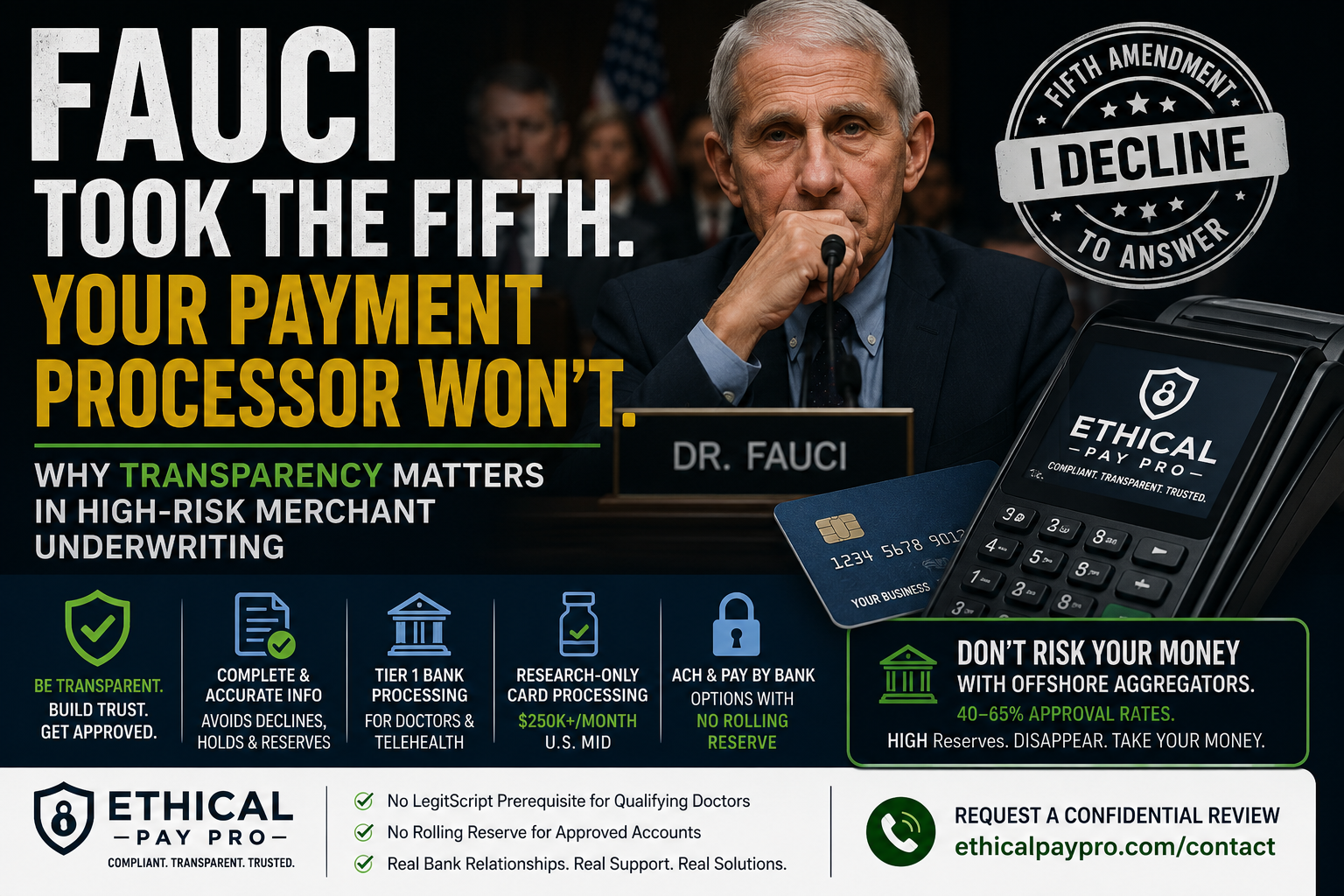
On July 29, 2026, Dr. Anthony Fauci appeared before the Senate Homeland Security and Governmental Affairs Committee and repeatedly invoked his Fifth Amendment right against self-incrimination rather than answer questions about the federal government’s COVID-19 response.
The hearing immediately produced a predictable public reaction:
If someone says they did nothing illegal, why would they need to take the Fifth?
That is a fair question from a public-relations standpoint, but it is not a legal conclusion.
The Fifth Amendment protects a person from being compelled to provide testimony that could be used against them. A witness may maintain innocence and still invoke the privilege if an answer could provide evidence or become a link in a potential prosecution. Invoking the Fifth does not, by itself, prove that a person lied or committed a crime.
But the hearing still offers an important lesson for doctors, telehealth providers, peptide companies, research suppliers, and other high-risk merchants:
When the Story Doesn’t Add Up, Trust Disappears
A congressional hearing and a merchant-account application are very different proceedings.
Congress must respect a witness’s constitutional rights. An acquiring bank has no obligation to approve a merchant it does not understand or trust.
When an applicant tells a bank that everything is legitimate but refuses to provide documents, gives incomplete answers, or submits information that conflicts with its website, the underwriter does not have to prove wrongdoing.
The bank can simply decline the account.
That is why transparency is one of the most important elements of high-risk merchant underwriting.
The Optics Matter, Even When the Law Is Clear
Anthony Fauci’s decision to invoke the Fifth does not establish guilt. His attorneys may have concluded that answering questions created legal exposure, regardless of whether he believed he had committed a crime. That is precisely the type of situation the constitutional protection is designed to address.
However, the public does not always separate constitutional protections from public perception.
When someone maintains that nothing improper occurred but will not answer direct questions, people naturally begin asking whether they are hearing the complete story.
The same thing happens in payment processing.
A merchant may say:
- “We are strictly research-only.”
- “We are not selling products for human use.”
- “We only charge for medical consultations.”
- “We do not fulfill prescriptions.”
- “We have never had a processing problem.”
Those statements mean very little if the website, application, transaction history, marketing materials, and supporting documents tell a different story.
In Merchant Underwriting, Lying Never Gets You Anywhere
Presenting false or misleading information may occasionally get an application past an inexperienced salesperson. It will not create a stable merchant account.
Banks conduct due diligence before approval and continue monitoring merchants after processing begins. They may compare the information on the original application with the merchant’s website, billing activity, chargebacks, transaction descriptions, fulfillment records, licensing, social media, and advertising.
If the story changes after approval, the consequences can include:
- Delayed deposits
- Increased reserves
- Additional underwriting reviews
- Sudden processing limits
- Frozen funds
- Account termination
- Placement on industry monitoring databases
- Greater difficulty obtaining another merchant account
Hiding information does not reduce risk. It transfers the risk to a later date, when the merchant may have significantly more money in pending deposits and reserves.
Your Processor Will Compare Everything
High-risk underwriting is not based on one document.
An acquiring bank may review:
- The products displayed on your website
- The description on your merchant application
- Your merchant category code
- Product labels and disclaimers
- Medical, pharmacy, or professional licenses
- Supplier and fulfillment relationships
- Marketing and social-media claims
- Refund and cancellation policies
- Recurring billing disclosures
- The name shown on customer statements
- Monthly volume and average transaction size
- Previous processor terminations
- Chargeback and refund history
For peptide companies, the distinction between a medical product and a research product is especially important.
A company cannot credibly apply as a laboratory research supplier while publishing human dosing information, treatment protocols, injection instructions, or testimonials describing personal results.
Similarly, a clinic cannot describe itself as offering consultations only when it is actually collecting payment for medications or unapproved substances.
The application, website, contracts, billing flow, and fulfillment model must tell the same story.
Research-Only Products Require a Different Processing Strategy
A legitimate research supplier is not the same type of merchant as a physician, telehealth provider, pharmacy, or wellness clinic.
Research businesses must be presented accurately to the bank. They should not be submitted as medical practices, supplement companies, chemical wholesalers, or another lower-risk category simply to obtain approval.
Ethical Pay Pro has access to a U.S. card-processing program for certain qualifying research-only merchants.
This is a direct U.S. merchant account with a U.S. merchant identification number, commonly called a MID. It is not an undisclosed overseas aggregation account.
Minimum Processing Volume
The U.S. card-processing program generally requires a minimum of:
$250,000 in Monthly Processing Volume
Approval is subject to complete underwriting and is not guaranteed.
The bank will review:
- The products being sold
- Website language and disclaimers
- Marketing practices
- Intended customer base
- Ownership and business history
- Fulfillment procedures
- Refund policies
- Chargeback exposure
- Previous processing history
- Whether the products are genuinely marketed for research use
This program is not intended for businesses using “research only” language as a cover for products marketed for personal or therapeutic use.
Why Offshore Aggregation Can Become Expensive
Some offshore aggregators advertise fast approvals for business categories that U.S. banks will not accept.
The initial approval may sound attractive, but the merchant needs to understand what it is actually receiving.
An aggregator normally places multiple businesses under a broader processing relationship. The merchant may not control a dedicated MID, may not know the acquiring bank, and may have limited direct recourse if deposits are delayed.
In our experience, some offshore peptide programs produce card authorization rates of approximately 40% to 65%. Actual performance depends on the card issuer, customer location, transaction amount, billing descriptor, acquiring region, fraud controls, and provider.
That means a merchant can spend heavily on advertising, attract a customer who is ready to purchase, and still lose the transaction because the customer’s card is declined.
Offshore aggregation may also involve:
- Inconsistent billing descriptors
- Frequent processor changes
- Large rolling reserves
- Long settlement periods
- Cross-border fees
- Sudden processing interruptions
- Limited access to the acquiring institution
- Difficulty recovering pending deposits
- Difficulty recovering reserves after an account closes
Not every offshore provider is dishonest, and not every offshore account will fail. However, merchants should recognize the additional counterparty risk.
Some aggregators eventually stop communicating, lose their underlying banking relationship, or fail to release reserves and pending deposits. By the time the merchant realizes there is a problem, a substantial amount of money may already be inaccessible.
A processor that approves the account quickly is not valuable if most transactions decline or the merchant cannot reliably receive its funds.
ACH and Pay by Bank for Research Peptide Companies
For qualifying research-only companies that do not meet the requirements for a U.S. card-processing account, Ethical Pay Pro also offers ACH and Pay by Bank options.
Pay by Bank allows customers to complete a purchase directly through their bank account rather than entering a credit or debit card.
The customer:
- Adds products to the cart and checks out normally.
- Selects Pay by Bank as the payment option.
- Chooses their financial institution.
- Signs in through the bank’s secure connection.
- Reviews and authorizes the transaction.
- Receives confirmation that the purchase is complete.
The merchant does not receive or store the customer’s online banking username or password.
Once approved, Pay by Bank can typically be added to a supported e-commerce platform in approximately 30 minutes. We support seven major platforms, including WordPress/WooCommerce and Wix.
Qualifying merchants may also be eligible for a no-reserve ACH program, meaning a percentage of every transaction is not automatically withheld in a rolling reserve. Funding remains subject to the merchant’s approved settlement schedule and banking terms.
ACH and Pay by Bank are payment methods. They do not change a product’s regulatory status or permit a business to market a research product for human use.
Doctors and Telehealth Providers Have Another Option
Licensed doctors and telehealth providers should not be underwritten in the same category as research peptide companies.
Most payment processors require online medical providers facilitating prescription transactions to obtain LegitScript certification before they will approve card-not-present payment processing.
Ethical Pay Pro has access to a Tier 1 acquiring bank program that may approve qualified doctors and telehealth providers without requiring LegitScript certification as a bank-level prerequisite.
The program is intended for legitimate healthcare businesses that:
- Use properly licensed medical providers
- Conduct real patient evaluations
- Establish valid doctor-patient relationships
- Prescribe or facilitate access to lawful, FDA-approved medications
- Use properly licensed dispensing pharmacies
- Follow applicable state telemedicine requirements
- Maintain transparent billing and refund practices
- Avoid misleading or unsupported medical claims
Qualified and approved accounts may receive:
- Credit and debit card processing
- Direct Tier 1 bank underwriting
- No LegitScript prerequisite
- No rolling reserve
- Competitive healthcare processing rates
- Support from underwriters familiar with telehealth
This is not a method for processing unapproved products or disguising a research business as a medical practice. All accounts remain subject to licensing verification, website review, product review, underwriting, and ongoing compliance.
Different Businesses Need Different Merchant Accounts
A licensed physician prescribing FDA-approved medications should not be submitted to a bank as a research supplier.
A research peptide company should not be presented as a medical practice.
A telehealth platform should not be described as an ordinary retail business.
A pharmacy should not be submitted as a professional-services merchant when it is actually dispensing medication.
Each model has different:
- Licensing requirements
- Product restrictions
- Card-network registrations
- Compliance obligations
- Chargeback risks
- Processing options
- Reserve requirements
The goal is not to find a processor willing to overlook the details.
The goal is to find an acquiring bank that understands the details and is willing to approve the business as it actually operates.
What a Credible Underwriting Story Looks Like
A strong merchant application should clearly explain:
What You Sell
Products and services must be accurately described. Avoid vague terms that hide the actual nature of the business.
Who Buys It
Identify whether your customers are patients, licensed researchers, universities, laboratories, medical practices, or consumers.
How Orders Are Fulfilled
The bank should understand who stores, ships, compounds, prescribes, or dispenses each product.
What Licenses Apply
Provide current medical, pharmacy, laboratory, business, and professional licenses when applicable.
How Customers Are Billed
The checkout experience, billing descriptor, recurring-payment terms, refund policy, and fulfillment timeline should be clearly disclosed.
Why Your Website Matches Your Application
The website should support the business model described to the underwriter. Product pages, disclaimers, blogs, testimonials, and social media should not contradict the application.
When these elements align, the bank can make an informed decision.
When they conflict, trust disappears.
The Lesson From the Fauci Hearing
The Fifth Amendment protects individuals from being compelled to incriminate themselves. Fauci’s decision to invoke it does not establish that he lied or committed a crime.
But the public reaction demonstrates something every high-risk merchant should understand:
Unanswered questions and conflicting explanations create doubt.
In merchant underwriting, the bank does not have to prove that you did something wrong.
It only has to decide that it is not comfortable accepting the risk.
Lying never creates a stable processing relationship. Neither does hiding products, changing business descriptions, using misleading disclaimers, or submitting an application under the wrong category.
At Ethical Pay Pro, we do not disguise business models.
We review the merchant’s website, products, licenses, processing history, fulfillment process, and transaction flow. We then identify the processing program that most accurately fits the business.
Depending on the model, available options may include:
- Tier 1 card processing for qualifying doctors
- Telehealth processing without a LegitScript prerequisite
- No-reserve processing for approved medical accounts
- U.S. card processing for qualifying research merchants processing at least $250,000 per month
- ACH for research-only businesses
- Pay by Bank integrations
- Website and underwriting-readiness reviews
Request a Confidential Payment-Processing Review
Your business should be presented honestly to an acquiring institution that understands the industry.
Before submitting an application, Ethical Pay Pro can review your:
- Products and services
- Website and marketing
- Processing volume
- Professional licenses
- Pharmacy or fulfillment relationships
- Refund policies
- Chargeback history
- Current processing arrangement
The purpose of the review is not to hide risk.
It is to explain the business accurately, identify potential problems before underwriting, and submit the application to the right financial institution.
Request a confidential payment-processing review.
This article is provided for general educational purposes and does not constitute legal, financial, medical, regulatory, or payment-network advice. Merchant accounts are subject to underwriting, licensing verification, bank approval, network rules, product review, and continued compliance.
Frequently Asked Questions
Does taking the Fifth mean someone is guilty?
No. The Fifth Amendment protects a person from being compelled to provide testimony that could be used against them. A person may maintain innocence and still invoke the privilege if an answer could provide a link in a possible prosecution.
Why did Anthony Fauci appear before the Senate?
Fauci appeared before the Senate Homeland Security and Governmental Affairs Committee on July 29, 2026, for a hearing examining his testimony and conduct related to the government’s COVID-19 response. He repeatedly invoked the Fifth Amendment during questioning.
Can research peptide businesses accept credit cards?
Certain qualifying research-only merchants may be eligible for a U.S. merchant account. Ethical Pay Pro’s applicable U.S. program generally requires at least $250,000 in monthly processing volume and complete underwriting.
What is a U.S. MID?
A MID is a merchant identification number associated with a merchant’s acquiring relationship. A direct U.S. MID gives an approved merchant a dedicated processing account rather than placing transactions through an undisclosed offshore aggregation arrangement.
What options are available below $250,000 per month?
Qualifying research-only businesses may be eligible for ACH or Pay by Bank processing. Approval depends on the products, website, business history, marketing practices, and underwriting review.
Can a telehealth doctor process without LegitScript?
Ethical Pay Pro has access to a Tier 1 bank program that may approve qualifying licensed doctors and telehealth providers without requiring LegitScript certification as a bank-level prerequisite. Approval is limited to eligible medical businesses and remains subject to complete underwriting.
Does the Tier 1 medical program require a reserve?
Approved merchants may qualify for processing without a rolling reserve. Final account terms depend on underwriting, licensing, products, transaction history, and the bank’s approval.