
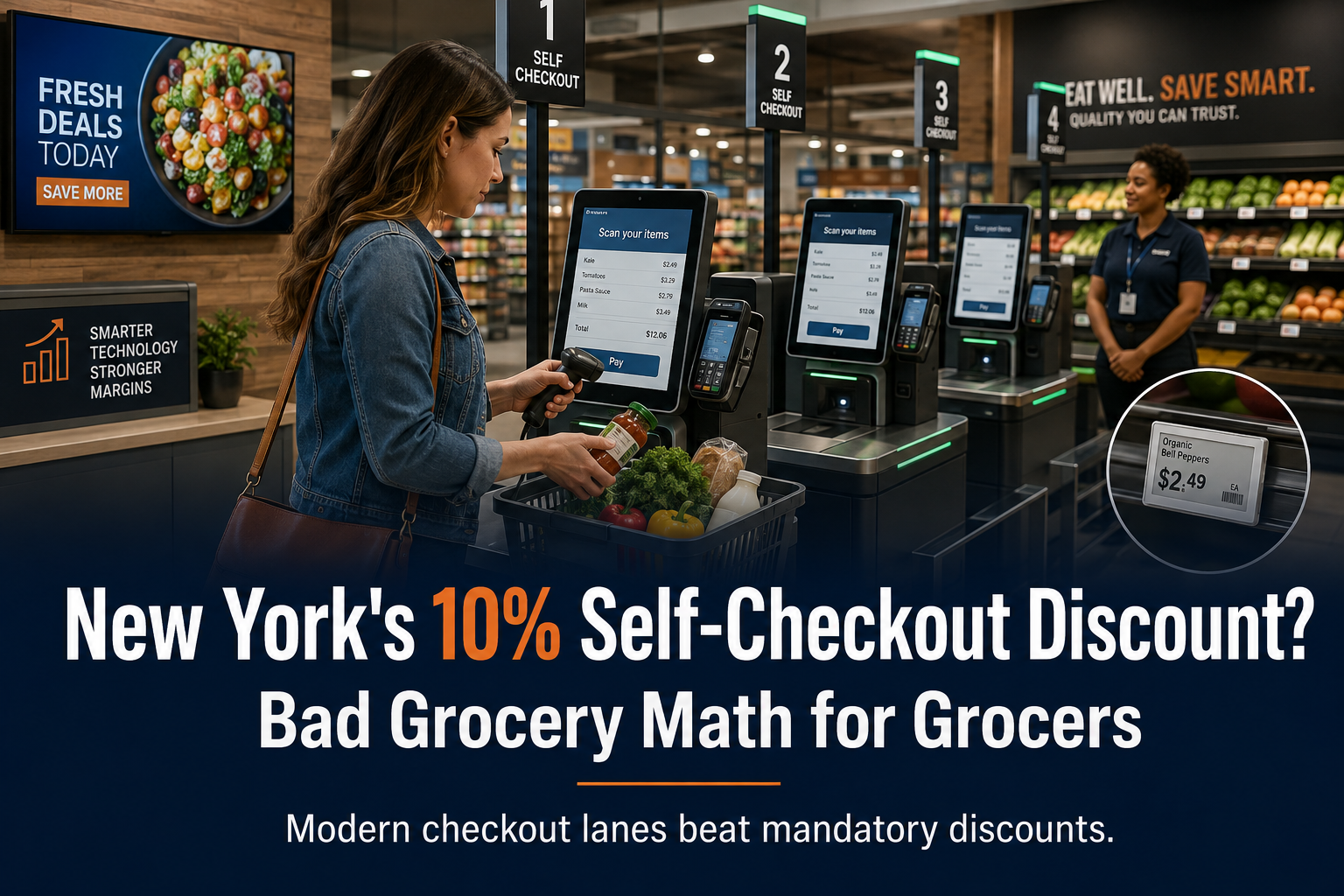
New York lawmakers have proposed a bill that would require supermarkets, grocery stores, and other food retailers to give customers a 10% discount on goods purchased through a self-service checkout kiosk.
Assembly Bill A11501 was introduced on May 28, 2026. It remains in the Assembly Consumer Affairs and Protection Committee and has not become law. (NYSenate.gov)
The proposal might sound consumer-friendly until someone runs the numbers.
Grocery stores already operate on razor-thin margins. Requiring them to surrender 10% of every self-checkout sale would not reasonably compensate shoppers for scanning their groceries. In many cases, the required discount would exceed the store’s entire profit several times over.
Grocery Stores Do Not Have a 10% Margin to Give Away
FMI, The Food Industry Association, reports that food retailers earned an average net profit margin of only 2.1% in 2025. The average in-store supermarket transaction was approximately $49.06, and self-checkout handled about 33% of supermarket transactions. (fmi.org)
Consider what the proposed discount would do to an average transaction:
- Average transaction: $49.06
- Estimated net profit at a 2.1% margin: $1.03
- Proposed 10% self-checkout discount: $4.91
- Discount compared with estimated profit: Nearly five times the store’s profit
The store would lose its entire estimated profit on that transaction, plus several additional dollars.
That calculation comes before considering theft, spoilage, equipment, maintenance, insurance, rent, utilities, card-processing costs, inventory losses and other operating expenses.
There is an even larger problem.
If self-checkout accounts for approximately 33% of transactions, a mandatory 10% discount on those transactions could reduce total store revenue by roughly 3.3%, assuming similar average tickets across checkout types.
That potential revenue reduction exceeds the industry’s average 2.1% net profit margin.
This is not a modest incentive. It could turn profitable transactions into losses.
A $15 Cashier Does Not Equal a $300 to $600 Hourly Discount
Supporters may argue that customers deserve a discount because they perform work previously handled by a cashier.
The arithmetic destroys that argument.
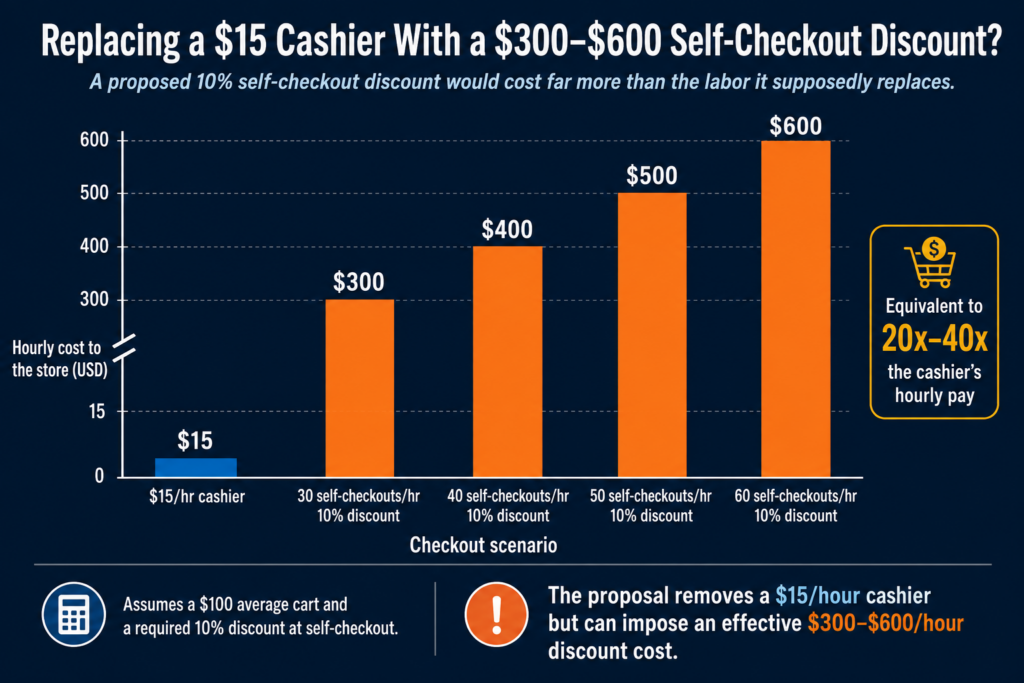
Consider a grocery store with a $100 average cart:
| Self-checkout transactions per hour | Sales processed | Required 10% discount |
|---|---|---|
| 30 | $3,000 | $300 |
| 40 | $4,000 | $400 |
| 50 | $5,000 | $500 |
| 60 | $6,000 | $600 |
A cashier earning $15 per hour does not cost the store $300 to $600 per hour.
Even if the cashier’s fully loaded cost reached $30 per hour after payroll taxes, benefits, workers’ compensation and other employment expenses, the proposed discount would still cost the store 10 to 20 times more than the employee.
At a $15 hourly wage, the required discount would equal 20 to 40 times the cashier’s hourly pay.
The proposal confuses transaction volume with labor savings. Generally, you see one employee overseeing two to four self checkout lanes. If your grocery store typically has one employee monitoring 4 lanes, the 10% discount will cost you 4x much.
In our above example at 30 self checkouts, a four lane self checkout with one employee cuts out 3 employees saving $45/hour, and would then be charged a $1200/hour tax!
A self-checkout kiosk also does not:
- Receive deliveries
- Stock and rotate inventory
- Clean the store
- Verify restricted purchases
- Operate the deli, seafood or meat department
- Help customers find products
- Correct pricing discrepancies
- Monitor shrink and theft
- Prepare pickup and delivery orders
Technology allows grocery stores to move employees into more valuable roles. It does not eliminate the store’s labor and operating costs.
The Real Grocery Checkout Problem Is Outdated Technology
Many independent grocery stores do not have too much technology.
They have old, slow and difficult-to-service technology.
Legacy grocery systems often create problems such as:
- Slow checkout lanes
- Frozen or unreliable registers
- Expensive proprietary equipment
- Limited inventory visibility
- Disconnected scales and label printers
- Manual shelf-price changes
- Delayed replacement hardware
- Dependence on a local dealer for every service call
When a checkout lane fails, the store starts losing throughput immediately.
Lines grow. Customers abandon purchases. Employees waste time moving shoppers between registers. Managers wait for a technician who may have little financial incentive to treat the repair as urgent.
A grocery store should not have to wait several weeks, or even several months, for a dealer to replace equipment that directly affects revenue.
The solution is not to penalize stores for offering self-checkout. The solution is to give grocery operators faster, more reliable and more affordable checkout technology.
Get Up to 25 Grocery Checkout Lanes With $0 Upfront Hardware Cost
Acadia POS offers qualifying grocery stores up to 25 complete checkout lanes with $0 upfront hardware cost.
The store pays a monthly software fee for each lane and fully owns the equipment after 16 months. (Acadia POS)
Depending on the approved store configuration, the offer can include:
- Two 15.6-inch HD touchscreen computers per lane
- Integrated payment terminals
- Thermal receipt printers
- Zebra scanner scales
- Cash drawers
- Poles, brackets, cables and mounting equipment
- An Acadia network router
This allows grocery operators to move away from outdated equipment without funding a massive hardware purchase before installation.
Offer approval, equipment quantities and final configurations depend on eligibility and the store’s operational requirements.
PAX Payment Devices Make Replacements Faster and Simpler
Acadia POS uses widely available PAX payment devices instead of locking grocery stores into obscure proprietary terminals that only one local dealer can supply.
Depending on local inventory, order cutoff times, dealer availability and shipping carriers, replacement PAX equipment may be available through:
- Same-day delivery from a local dealer
- Local pickup
- Overnight shipping
- One or two-business-day shipping
This availability can dramatically reduce the downtime associated with legacy grocery equipment.
Most PAX devices use straightforward power and ethernet connections.
In many cases, replacing a failed terminal involves:
- Disconnecting the existing power and Ethernet cables.
- Removing the terminal from its stand or bracket.
- Installing the replacement terminal.
- Reconnecting power and Ethernet.
- Entering the registration or activation code provided for the device.
Depending on the mounting hardware, the physical replacement typically requires removing and reinstalling only a few screws.
A manager or store employee who can handle basic cable connections can often complete the physical swap without waiting for an onsite technician. Acadia can then assist with device registration and activation.
Same-day or overnight replacement cannot be guaranteed in every market, but a nationwide hardware ecosystem gives stores far more replacement options than a closed legacy system supported by a single dealer.
Free Digital Menu Board Software Helps Move Perishable Inventory
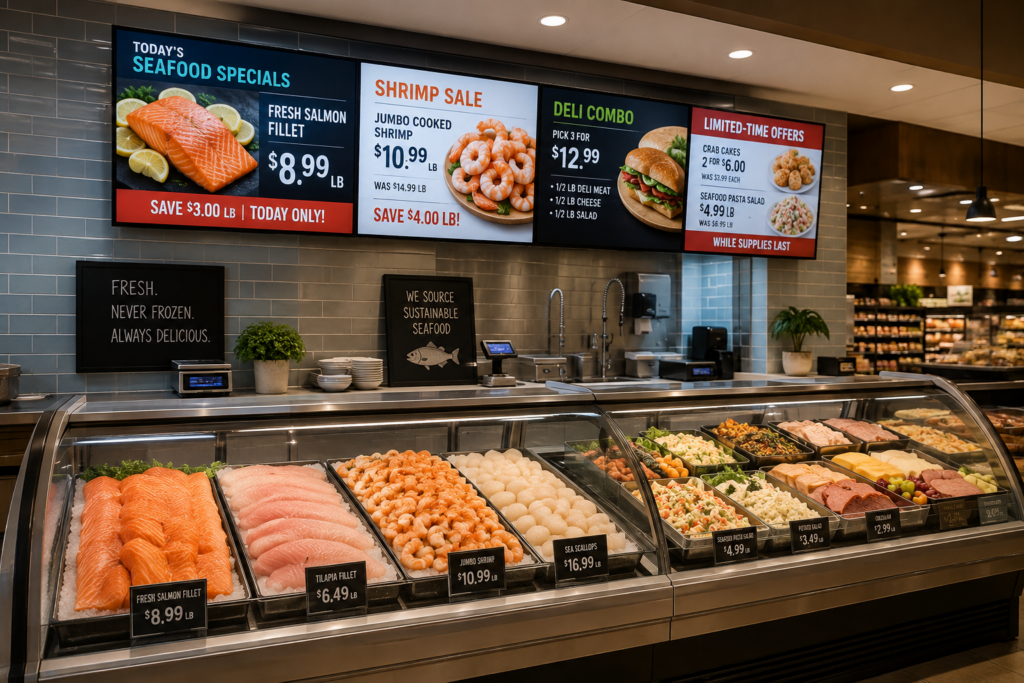
Grocery inventory does not become more valuable while it sits on a shelf.
Produce, meat, seafood, bakery products, prepared foods and dairy items all have limited selling windows. Stores need a fast way to promote products before they become waste.
Acadia’s digital menu board platform can help stores:
- Advertise daily and weekly specials
- Promote short-dated products
- Highlight excess inventory
- Feature deli, meat, seafood and bakery offers
- Display current prices
- Promote high-margin products
- Run store announcements
- Replace printed promotional signs
The digital menu board software is included at no additional platform charge. Stores can use compatible screens and televisions to display promotional content throughout the business for a one time charge of $100 per screen. Simply plug in our HDMI stick, and you’ll have full access control to what’s on the screen.
Instead of waiting for perishable inventory to expire, managers can immediately advertise it while it remains fresh and sellable.
A seafood manager could promote a same-day salmon special. A produce manager could discount excess strawberries. A deli could advertise prepared foods approaching the end of their ideal selling window.
The promotion can change in minutes without printing, distributing and hanging new signs.
Free Text-Marketing Platform With Automated Win-Back Campaigns
Most grocery stores collect valuable transaction data but fail to use it.
Acadia POS can track customer purchasing activity and use that information to create targeted text-marketing campaigns.
The marketing platform, campaign-building tools, customer segmentation, AI-generated promotional landing pages, creative content tools, image uploads and image storage are included without an additional platform charge.
Text-message delivery is usage-based, so stores pay only when they send messages. Message-delivery charges apply.
Stores can segment customers using information such as:
- Previous purchases
- Product preferences
- Lifetime spending
- Last shopping location
- Customer category
- Days since the customer’s last transaction
Acadia can automatically run win-back campaigns for customers who have not returned after:
- Seven days
- 30 days
- 60 days
- 90 days
The campaigns can use actual purchase behavior instead of sending every customer the same generic coupon.
For example:
A customer who regularly purchases seafood but has not returned in 30 days could receive a seafood promotion.
A customer who frequently buys prepared deli meals could receive an offer connected to the deli.
A customer who previously purchased premium meat could receive a promotion for an upcoming butcher-counter special.
This turns transaction history into repeat business instead of leaving the information buried inside a report.
Optional Digital Scales Improve Deli, Meat and Seafood Operations
Acadia also offers optional integrated digital scales for meat markets, delis, seafood departments and other weight-based areas.
An employee can weigh a product, select the item and print a scannable label containing the product’s weight and calculated price.
The label can then be attached to the package and scanned at checkout.
This process helps the store:
- Speed up checkout
- Reduce manual-entry errors
- Apply the correct price
- Track weighted products
- Remove sold quantities from inventory
- Keep product information consistent
- Improve department-level reporting
Acadia’s grocery platform supports scanners, deli scales, label creation and real-time inventory management. (Acadia POS)
The cashier does not need to identify the product, enter the weight or calculate the selling price manually. The department handles that information when preparing and labeling the package.
Electronic Shelf Labels Eliminate Manual Price Changes
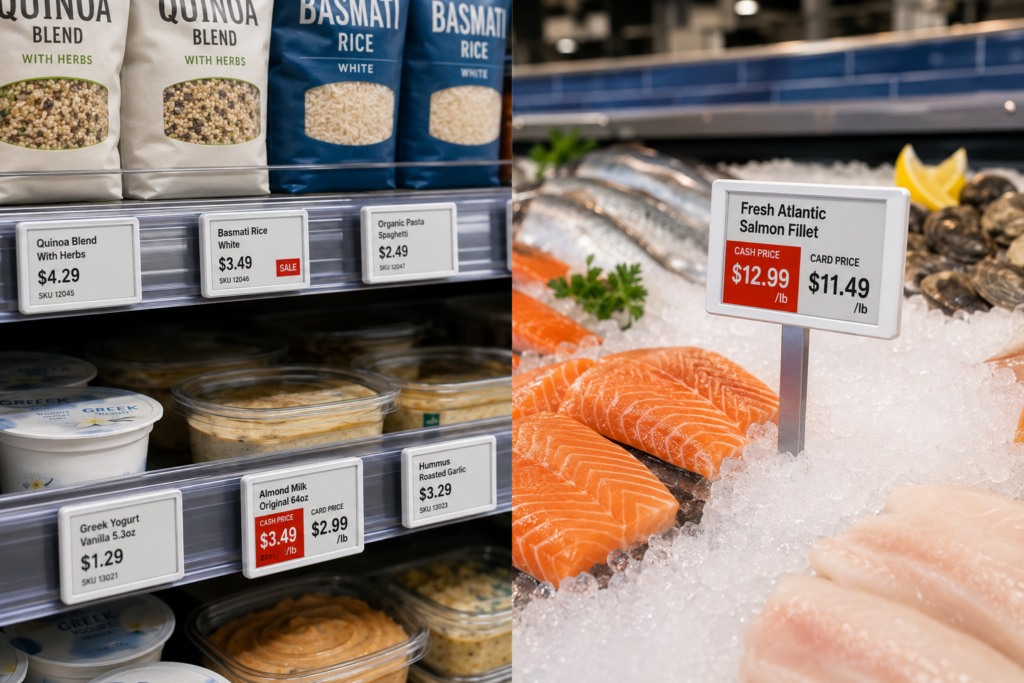
Traditional paper shelf tags force employees to walk through aisles every time the store changes a price or starts a promotion.
That process wastes labor and creates opportunities for errors.
Optional electronic shelf labels allow stores to update pricing and product information directly from Acadia POS. The grocery platform supports real-time pricing and product data, including electronic shelf tags designed for automated pricing. (Acadia POS)
Electronic shelf labels can help stores:
- Update prices without replacing paper tags
- Launch promotions faster
- Reduce shelf-to-register pricing discrepancies
- Display cash and credit pricing
- Improve price accuracy
- Reduce repetitive employee work
- Manage frequent supplier cost changes
- Coordinate pricing across multiple locations
- Identify low stock items by flashing.
The labels are available for purchase and can save substantial labor in stores managing thousands of products.
Stop Letting Legacy POS Equipment Control Your Store
A grocery store should not have to choose between outdated checkout equipment and a massive capital expense.
It should not wait weeks for a dealer to replace a failed register.
It should not manually change thousands of shelf tags whenever prices move.
It should not let valuable customer transaction data sit unused.
And it should not have to surrender 10% of a customer’s purchase because lawmakers misunderstand grocery-store economics.
Acadia POS gives qualifying grocery stores a practical path toward modernization:
- Up to 25 checkout lanes with $0 upfront hardware cost
- Integrated payment terminals
- Zebra scanner scales
- Cash drawers and receipt printers
- Free digital menu board software
- Free text-marketing and campaign platform
- Automated seven, 30, 60 and 90-day win-back campaigns
- AI-generated promotional landing pages
- Optional integrated deli and weight-based scales
- Optional electronic shelf labels
- Real-time inventory management
- Customer purchasing and reporting tools
- Widely available PAX payment equipment
- Potential same-day, overnight or expedited replacement options
- Professional and seamless installation, training, and launch
Modern grocery technology should make stores faster, more competitive and more profitable.
It should not punish them for becoming more efficient.
Upgrade Your Grocery Store Without a Massive Upfront Hardware Bill
Qualifying grocery stores can receive up to 25 complete Acadia POS checkout lanes with $0 upfront hardware cost.
Pay a monthly software fee for each lane and own the equipment after 16 months.
Review the Acadia POS grocery-store promotion and request an eligibility consultation today. (Acadia POS)