

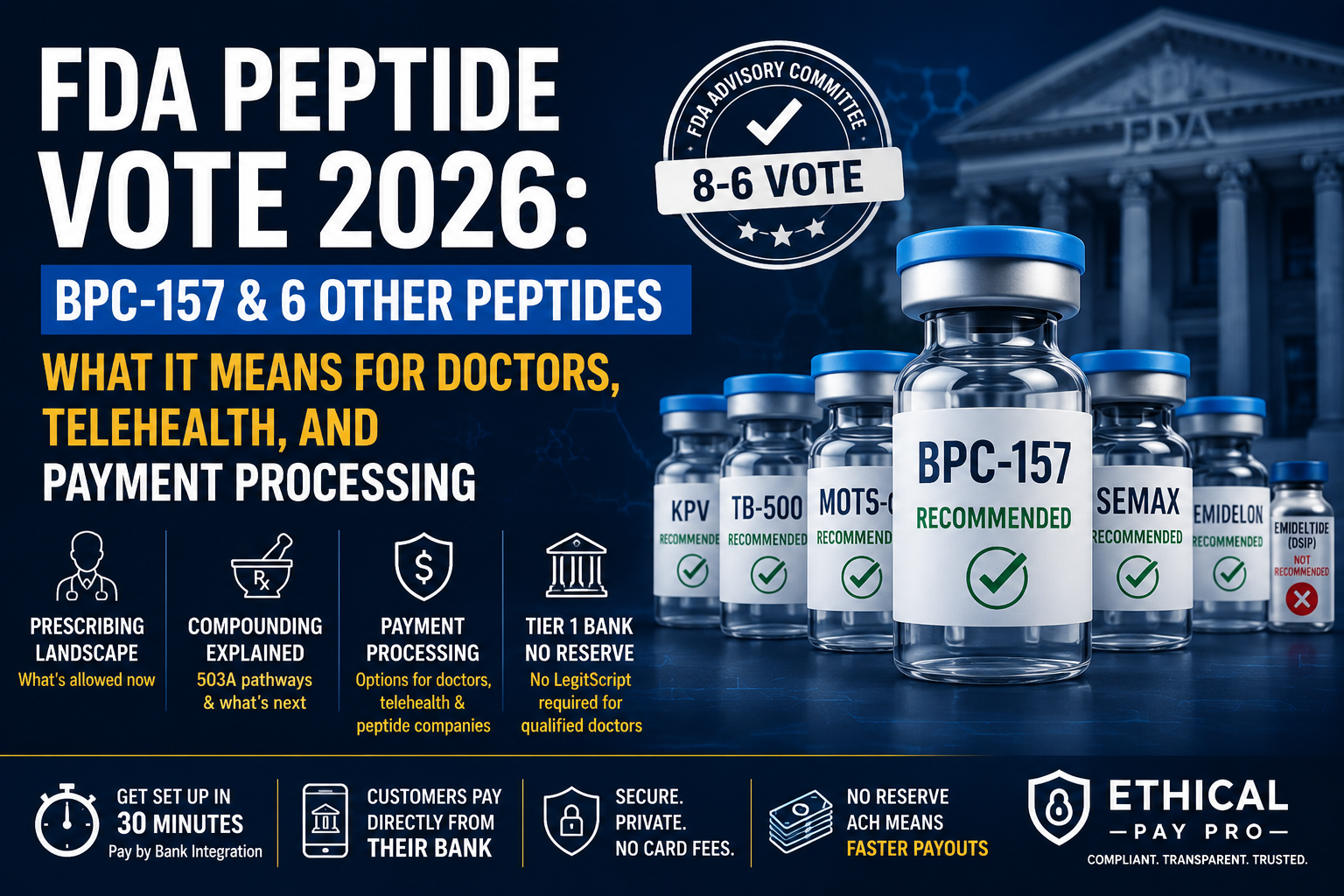
The peptide industry received major news on July 23 and 24, 2026, when the FDA’s Pharmacy Compounding Advisory Committee reviewed seven popular peptide families for possible inclusion on the Section 503A Bulk Drug Substances List.
BPC-157 generated most of the headlines after receiving an 8–6 favorable vote, with one abstention, but it was only one part of a much broader FDA meeting.
The committee recommended six peptide families for possible inclusion:
- BPC-157
- KPV
- TB-500
- MOTS-c
- Epitalon
- Semax
Emideltide, also known as DSIP, was the only peptide that did not receive a favorable recommendation.
This is significant news for physicians, telehealth providers, compounding pharmacies, peptide suppliers, and payment processors. However, the vote is being widely misunderstood.
The committee did not FDA-approve BPC-157 or any of the other peptides. It issued nonbinding recommendations concerning potential compounding eligibility.
The FDA must still decide whether to accept those recommendations and complete the formal process required to change each substance’s federal compounding status.
What Exactly Did the FDA Committee Vote On?
The committee was not deciding whether these peptides had been proven safe and effective as FDA-approved medications.
It was considering whether certain free-base and acetate forms should be recommended for inclusion on the 503A Bulk Drug Substances List.
That list helps determine which bulk drug substances state-licensed pharmacies, federal facilities, and licensed physicians may use when preparing medications under Section 503A of the Federal Food, Drug, and Cosmetic Act.
The FDA’s official agenda identified seven peptide families and the proposed uses that the agency evaluated. Those proposed uses were part of the committee’s review; they were not FDA-approved indications or endorsements of effectiveness.
The Committee Reviewed Seven Peptides, Not Just BPC-157
The reported results were as follows:
| Peptide | Use evaluated by the FDA | Committee result | Reported vote |
|---|---|---|---|
| BPC-157 | Ulcerative colitis | Recommended | 8–6, 1 abstention |
| KPV | Wound healing and inflammatory conditions | Recommended | 8–6, 1 abstention |
| TB-500 | Wound healing | Recommended | 8–6, 1 abstention |
| MOTS-c | Obesity and osteoporosis | Recommended | 7–5, 2 abstentions |
| Epitalon | Insomnia | Recommended | 7–4, 1 abstention |
| Semax | Cerebral ischemia, migraine, and trigeminal neuralgia | Recommended | 8–5, 1 abstention |
| Emideltide/DSIP | Opioid withdrawal, chronic insomnia, and narcolepsy | Not recommended | 6–7, 1 abstention |
The FDA considered related forms separately where applicable, but the table summarizes the reported result for each peptide family. Six of the seven families received favorable recommendations, while emideltide was narrowly rejected.
What Role Did RFK Jr. Play?
Health and Human Services Secretary Robert F. Kennedy Jr. has publicly expressed support for broader access to peptide therapies and has discussed his own positive experience with peptides.
His support helped bring additional political and public attention to peptide access. However, RFK Jr. did not personally approve BPC-157, issue prescriptions for it, or make the reviewed peptides immediately lawful for routine compounding.
The July votes were conducted by the FDA’s Pharmacy Compounding Advisory Committee. The committee advises the FDA, but its recommendations are not binding. The FDA remains responsible for any final regulatory action.
FDA Approval and Compounding Eligibility Are Not the Same
This is the most important distinction for doctors, telehealth companies, pharmacies, and peptide businesses.
FDA-approved medication
An FDA-approved drug has completed the agency’s formal review process for safety, effectiveness, manufacturing quality, and labeling.
A healthcare provider may generally prescribe an approved drug for its approved indication. A provider may also use professional medical judgment to prescribe an approved medication for an unapproved—or “off-label”—use.
However, off-label prescribing still begins with an FDA-approved drug. It does not mean a doctor may automatically prescribe any unapproved chemical or research substance for human treatment.
Lawfully compounded medication
Compounded medications are not FDA approved. The FDA does not review individual compounded medications for safety, effectiveness, or quality before they reach patients.
Nevertheless, a provider may prescribe a compounded medication when it is lawfully prepared under the applicable federal and state compounding framework.
Under Section 503A, the bulk drug substance generally must:
- Comply with an applicable USP or National Formulary monograph;
- Be a component of an FDA-approved drug when no applicable monograph exists; or
- Appear on the FDA’s 503A Bulk Drug Substances List.
Other requirements apply, including rules concerning patient-specific prescriptions, ingredient sourcing, certificates of analysis, pharmacy licensing, manufacturing, and dispensing.
Research-use-only product
A product sold for legitimate laboratory research is not a prescription medication and cannot be marketed or dispensed for human treatment.
Adding “research use only” or “not for human consumption” to a product page does not automatically protect the seller. The FDA evaluates the entire business, including product descriptions, dosing information, injection instructions, testimonials, social media, bundled supplies, and claims about human results.
In recent warning letters, the FDA has determined that products labeled for research were actually being promoted as unapproved human drugs because the companies’ websites and marketing demonstrated an intended human use.
Can a Doctor Prescribe BPC-157 Today?
The July 2026 advisory vote did not immediately create a routine prescribing or compounding pathway for BPC-157.
As of this article’s publication:
- BPC-157 is not an FDA-approved medication.
- It has not yet been formally added to the final 503A Bulk Drug Substances List.
- The committee’s 8–6 vote is advisory and nonbinding.
- A doctor’s prescription alone does not make an otherwise ineligible bulk drug substance lawful for a 503A pharmacy to compound.
A doctor also cannot rely on ordinary off-label prescribing because off-label prescribing involves an FDA-approved drug being used for an unapproved indication, dose, route, or patient group. There is currently no FDA-approved BPC-157 drug serving as the starting point for ordinary off-label prescribing.
Therefore, a doctor or telehealth company should not interpret the vote as permission to immediately advertise BPC-157 treatment, collect payment for BPC-157 prescriptions, and send those prescriptions to an ordinary compounding pharmacy.
A clinical trial or FDA expanded-access pathway may be available in limited investigational circumstances, but expanded access is generally reserved for serious or immediately life-threatening conditions when there is no satisfactory alternative. It requires a separate FDA-regulated process and is not a routine commercial wellness or telehealth model.
What Could Change if the FDA Accepts the Recommendation?
If the FDA formally adds BPC-157 or another recommended peptide to the 503A Bulk Drug Substances List, a future model could potentially involve:
- A licensed medical provider evaluating an identified patient.
- The provider establishing a valid doctor-patient relationship.
- The provider determining that a compounded medication is medically appropriate.
- The provider issuing a patient-specific prescription.
- A properly licensed pharmacy preparing and dispensing the medication.
- Every participant complying with the laws of the states where the provider, pharmacy, and patient are located.
Even then, the compounded medication would not become FDA approved.
A clinic or telehealth company could not accurately market it as:
- FDA approved;
- An FDA-approved generic;
- Proven equivalent to an FDA-approved medication;
- Reviewed by the FDA for safety or effectiveness; or
- Manufactured by an “FDA-approved pharmacy.”
The FDA has recently warned telehealth companies about advertising that falsely suggests compounded products are FDA approved, generic versions of approved medications, or evaluated by the agency for safety and effectiveness.
Why Peptide and Telehealth Payment Processing Is Complicated
Banks do not approve a medical or peptide merchant account simply because a licensed doctor is involved.
Payment underwriters may review:
- The exact medications or products offered;
- Whether the medications are FDA approved or compounded;
- The patient evaluation and prescribing process;
- Provider licenses in each relevant state;
- The dispensing pharmacy and its licenses;
- The relationship between the medical practice, telehealth platform, and pharmacy;
- Website and social-media claims;
- Recurring billing practices;
- Refund and cancellation policies;
- Fulfillment procedures;
- Chargeback history; and
- Whether the merchant’s actual activity matches the business model disclosed to the bank.
A physician’s license does not automatically make every product or website acceptable to an acquiring bank.
A medical office providing legitimate professional services is different from an online pharmacy. A telehealth company facilitating access to FDA-approved medication is different from a research peptide supplier. A licensed compounding pharmacy is different from a clinic that markets unapproved products directly to consumers.
Those differences determine which banks, payment methods, registrations, and underwriting programs may be available.
Why Most Processors Require LegitScript Certification
Pharmacies and telemedicine providers processing card-not-present pharmaceutical transactions are generally treated as high-risk healthcare merchants.
LegitScript Healthcare Merchant Certification is recognized by major card networks and is commonly used by acquiring banks and payment service providers when evaluating online pharmacies and telemedicine businesses.
Many mainstream processors require certification before they will approve a telehealth or online prescription-drug merchant. In practice, an uncertified telehealth provider may find that most conventional processing options are unavailable, even when licensed doctors and legitimate pharmacies are involved.
LegitScript may examine areas such as:
- Professional licensing;
- Patient safety;
- Telemedicine procedures;
- Prescription fulfillment;
- Pharmacy relationships;
- Website transparency;
- Marketing practices; and
- Compliance with applicable laws.
Certification can be valuable, but it does not make an unlawful product lawful. It also does not replace FDA authorization, medical licensing, pharmacy licensing, or bank underwriting.
No LegitScript Certification? Ethical Pay Pro May Have an Alternative
This is where Ethical Pay Pro differs from most payment processors.
We have access to a Tier 1 acquiring bank relationship that may accept qualified licensed doctors, medical practices, and telehealth providers without requiring LegitScript certification as a prerequisite for the merchant account.
This program is designed for legitimate healthcare businesses that use licensed medical providers and prescribe or facilitate access to lawful, FDA-approved medications.
A qualifying merchant may include a doctor or telehealth company that:
- Uses properly licensed medical providers;
- Conducts legitimate patient evaluations;
- Establishes a valid doctor-patient relationship;
- Prescribes FDA-approved medications;
- Complies with applicable state telemedicine laws;
- Uses properly licensed dispensing pharmacies;
- Clearly identifies the providers and pharmacies involved;
- Maintains transparent billing and cancellation policies; and
- Avoids unsupported or misleading medical claims.
For approved businesses, the program may provide:
- Credit and debit card acceptance;
- Direct underwriting through a Tier 1 acquiring relationship;
- No bank-level LegitScript prerequisite;
- No rolling reserve for approved accounts;
- Competitive healthcare processing rates; and
- Underwriting support from a team that understands telehealth and prescription-drug business models.
This is especially important for licensed doctors and telehealth providers that have legitimate medical practices but cannot obtain conventional processing because they have not completed the LegitScript certification process.
This program is not a workaround for unapproved products
The bank will still examine the merchant’s:
- Medical licenses;
- Products and medications;
- Prescribing procedures;
- Pharmacy relationships;
- Website language;
- Marketing claims;
- Fulfillment process;
- Processing history; and
- Overall regulatory compliance.
The program cannot be used to disguise a research peptide company as a medical practice or to process sales of unapproved products intended for human consumption.
The favorable BPC-157 committee vote does not currently make a BPC-157 telehealth program eligible for the FDA-approved medication pathway.
If the FDA eventually creates a lawful compounding pathway, banks will still need to decide whether compounded BPC-157 fits their underwriting policies.
Processing for Doctors Who Prescribe FDA-Approved Medications
A licensed physician or telehealth provider offering FDA-approved medications should not automatically be forced into an expensive, reserve-heavy merchant account simply because the business operates online.
Ethical Pay Pro can review the medical and fulfillment model before an application is submitted. This helps determine whether the practice may qualify for our Tier 1 bank program without LegitScript certification and without a rolling reserve.
The review typically considers:
- Provider and pharmacy licenses;
- The list of medications offered;
- The states where patients are accepted;
- The consultation process;
- Prescription and fulfillment procedures;
- Website disclosures;
- Refund and cancellation policies; and
- Previous processing history.
Every account remains subject to bank approval and continued compliance, but submitting the business to the correct underwriting program can make a substantial difference.
What About Compounded Peptide Medications?
Payment processing for compounded medications requires a separate review.
A bank will ordinarily want to understand:
- Whether the active ingredient may lawfully be compounded;
- Why a compounded medication is medically appropriate;
- Whether prescriptions are patient specific;
- Which pharmacy prepares and dispenses the medication;
- Whether the pharmacy is licensed in the patient’s state;
- How the clinic discloses that the medication is compounded;
- Whether the website avoids FDA-approval claims; and
- Whether medical and marketing claims are adequately supported.
Compounded medications can serve legitimate patient needs, but they are not reviewed or approved by the FDA before marketing. The payment-processing application must accurately describe the difference.
ACH and Pay-by-Bank for Research Peptide Companies
Ethical Pay Pro also offers ACH and pay-by-bank processing options for qualifying companies operating in the legitimate research-use market.
These options may help a research supplier that cannot qualify for conventional credit card processing. However, ACH and pay-by-bank are payment methods—not regulatory exemptions.
A research supplier should not:
- Provide human dosing instructions;
- Recommend injections or personal use;
- Make disease-treatment claims;
- Publish human-use protocols;
- Display before-and-after treatment claims;
- Use testimonials describing human results;
- Bundle peptides with syringes or treatment supplies; or
- Use research disclaimers while clearly targeting patients seeking treatment.
The business must be accurately presented to the underwriting institution as a research supplier. Ethical Pay Pro does not disguise products, alter business descriptions, or use payment processing to evade FDA or card-network requirements.
How Pay by Bank Works
Once your merchant account is approved, Pay by Bank can typically be added to your website in approximately 30 minutes. We support seven leading website and e-commerce platforms, including WordPress/WooCommerce and Wix.
1. Add Pay by Bank to Your Checkout
Our team connects Pay by Bank to your existing website and checkout. There is no need to rebuild your store or change how customers add products to their cart.
2. The Customer Checks Out as Usual
The customer fills their cart, proceeds to checkout, and selects Pay by Bank as the payment method instead of entering a credit or debit card.
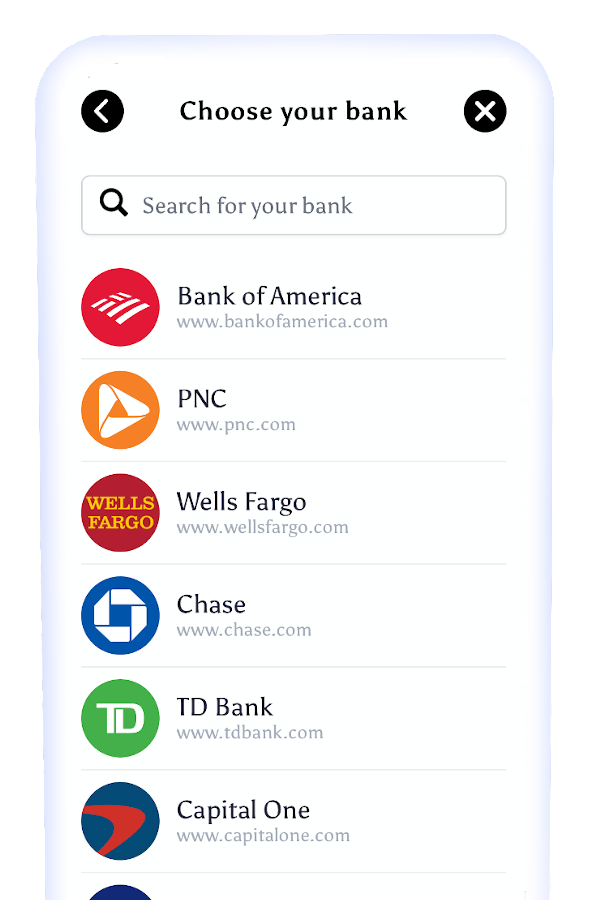
3. The Customer Selects Their Bank
A secure bank-selection window opens on the customer’s phone. The customer chooses their financial institution and signs in through the bank’s secure connection.
Ethical Pay Pro and the merchant do not receive or store the customer’s online banking username or password.
4. The Customer Authorizes the Payment
The customer reviews the transaction and authorizes the funds directly through their bank account.
5. The Order Is Completed
Once authorization is confirmed, the checkout is completed and the merchant receives confirmation of the transaction—without relying on traditional card processing.
6. No Reserve Means Faster Access to Your Money
With our no-reserve ACH program, funds are deposited in days, not weeks.
Fast Setup With No Complicated Checkout Changes
Pay by Bank gives qualifying merchants a convenient alternative to credit card processing while allowing customers to complete purchases through a familiar, secure bank-login experience.
Already approved? Your integration may be completed in as little as 30 minutes.
What Peptide Companies Should Do While Waiting for FDA Action
The industry is waiting for the FDA’s final decision on compounding eligibility, not traditional FDA drug approval.
Doctors, telehealth providers, compounding pharmacies, and peptide suppliers should use this period to review:
- Product classifications;
- Medical and pharmacy licenses;
- Patient-evaluation procedures;
- Prescribing workflows;
- Pharmacy agreements;
- Website and social-media claims;
- Compounded-drug disclosures;
- Research-use marketing;
- Payment-processing structure;
- Refund and cancellation policies; and
- LegitScript eligibility.
Businesses that prepare now will be in a much stronger position if the FDA formally changes the status of BPC-157, KPV, TB-500, MOTS-c, Epitalon, or Semax.
Payment Processing for Medical, Telehealth, and Peptide Businesses
Ethical Pay Pro understands that these businesses do not all belong in the same underwriting category.
A licensed doctor prescribing FDA-approved medication should not be evaluated like a research chemical supplier. A telehealth platform should not be presented as a retail pharmacy. A compounding pharmacy should not be submitted as an ordinary medical office.
Depending on the business model, Ethical Pay Pro may be able to provide:
- Card processing for qualifying licensed doctors;
- Telehealth payment processing without LegitScript certification;
- A Tier 1 acquiring bank program with no rolling reserve for approved accounts;
- Processing for providers prescribing FDA-approved medications;
- Support for businesses that already hold LegitScript certification;
- ACH processing for qualifying research suppliers;
- Pay-by-bank options;
- Website and underwriting-readiness reviews; and
- Guidance on the documents acquiring banks are likely to request.
Request a Confidential Payment Processing Review
Before submitting your application, we can review your products, website, licensing, medical model, pharmacy relationships, and previous payment-processing history.
Our objective is not to disguise your business model.
Our objective is to identify the correct processing category and present your business accurately to an acquiring bank that understands it.
Request a Confidential Payment Processing Review
This article is provided for general educational purposes and does not constitute legal, medical, pharmacy, payment-network, or regulatory advice. Merchant accounts are subject to bank underwriting, card-network requirements, licensing verification, product review, and continued compliance.
Frequently Asked Questions
Did the FDA approve BPC-157 in July 2026?
No. An FDA advisory committee recommended BPC-157 for possible inclusion on the Section 503A Bulk Drug Substances List. The vote was nonbinding and was not FDA drug approval.
Which peptides received favorable votes?
The committee recommended BPC-157, KPV, TB-500, MOTS-c, Epitalon, and Semax. Emideltide, also known as DSIP, did not receive a favorable recommendation.
Can doctors prescribe BPC-157 now?
The committee vote did not establish an immediate routine prescribing or 503A compounding pathway. BPC-157 has not yet been formally added to the 503A Bulk Drug Substances List.
Can a doctor prescribe a medication that is not FDA approved?
A doctor may prescribe a lawfully compounded medication even though compounded medications are not FDA approved. However, the medication, active ingredient, prescription, pharmacy, and dispensing process must satisfy the applicable federal and state requirements.
Do telehealth providers need LegitScript to accept credit cards?
Many mainstream processors and acquiring banks require LegitScript certification for telemedicine and online pharmaceutical merchants. Ethical Pay Pro also has a Tier 1 bank program that may accept qualifying licensed doctors and telehealth providers without LegitScript certification.
Does Ethical Pay Pro’s program require a rolling reserve?
Qualified merchants approved through the applicable Tier 1 bank program may receive processing with no rolling reserve. Approval depends on the products, licenses, website, prescribing model, pharmacy relationships, and complete underwriting review.
Can research peptide companies accept ACH payments?
Ethical Pay Pro offers ACH and pay-by-bank options for qualifying research suppliers. These payment methods do not authorize human use or exempt a business from FDA, state, or other regulatory requirements.