
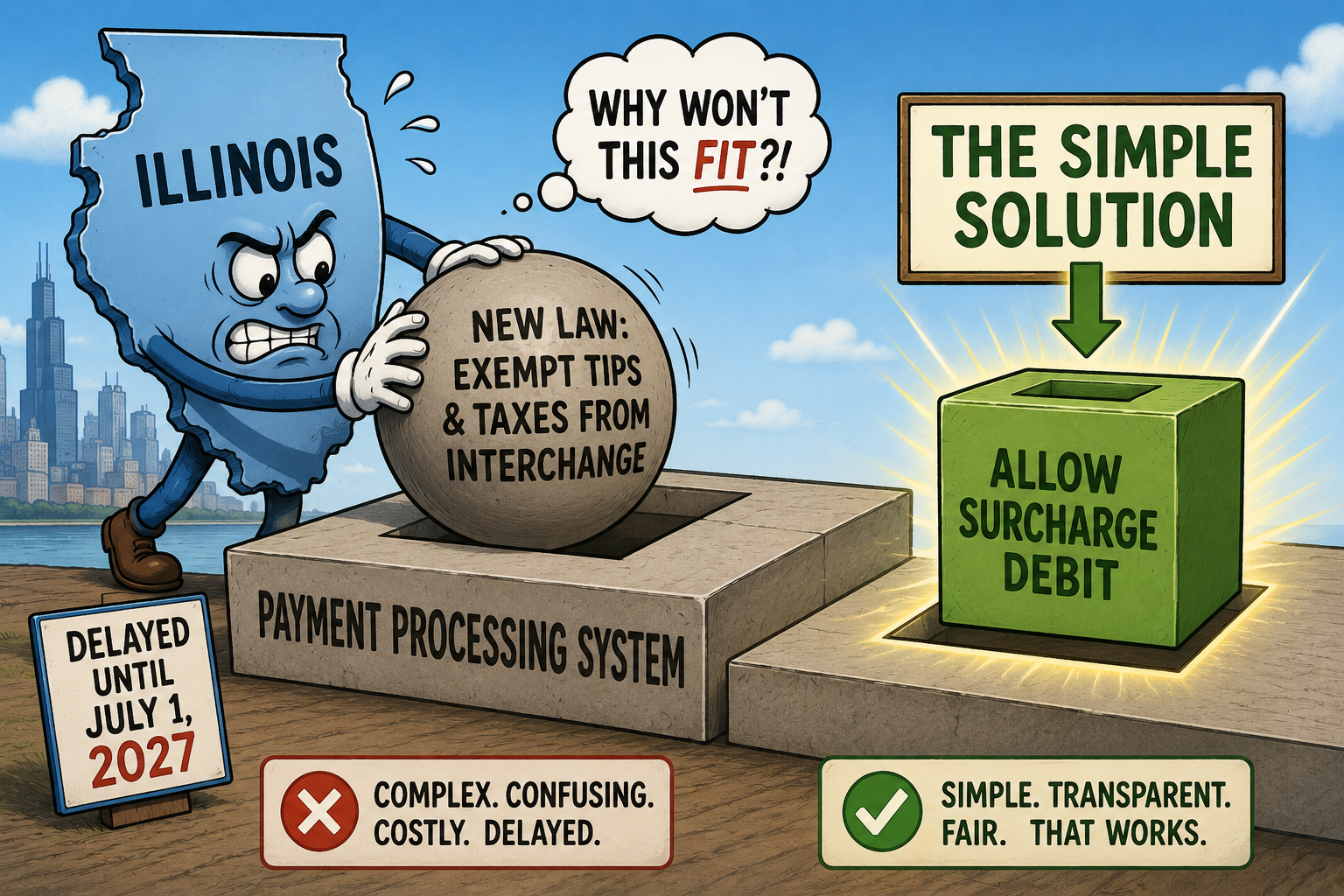
For the second consecutive year, Illinois lawmakers have postponed implementation of the state’s Interchange Fee Prohibition Act (IFPA). What was originally scheduled to take effect in 2025 has now been pushed back again, this time until July 1, 2027, as lawmakers, regulators, courts, and the payments industry continue to wrestle with a law that sounded simple on paper but has proven extraordinarily difficult to implement.
That shouldn’t surprise anyone who understands how payment processing actually works.
The IFPA attempts to prohibit interchange fees from being charged on the tax and gratuity portions of a card transaction. While that may sound like a straightforward way to save merchants money, it forces every participant in the payment ecosystem to answer operational questions that never existed before.
Here’s one of them.
Imagine LeBron James walks into your neighborhood bar. He has an incredible evening and leaves your bartender a $2,000,000 tip on his credit card.
At a 3% processing rate, the merchant would pay approximately $60,000 in processing costs on that gratuity alone.
Who should absorb that cost?
Should the restaurant be forced to lose $60,000 because a customer chose to pay with a credit card?
Or should the employer be allowed to deduct the actual processing expense attributable to that gratuity, as federal law generally permits in many states?
Most people dismiss this as an absurd hypothetical.
That’s exactly why it’s useful.
Edge cases expose whether legislation reflects how the real world works. If a law produces unreasonable outcomes at the extremes, it often reveals deeper problems with the framework itself. The IFPA has become a textbook example.
There’s a Simpler Solution
If lawmakers want to make payment costs more transparent without forcing the entire payments ecosystem to reinvent how transactions are processed, there’s a much simpler approach.
Congress should amend the Durbin Amendment to allow merchants to surcharge debit card transactions, just as they can for most credit card transactions today.
Instead of creating complicated rules that require processors, banks, card networks, and POS systems to separate taxes and gratuities for interchange calculations, merchants could simply disclose the cost of electronic payments to consumers and let the market work.
That’s a far cleaner solution than rewriting the rules of payment processing.
Sometimes the simplest answer really is the best one.