
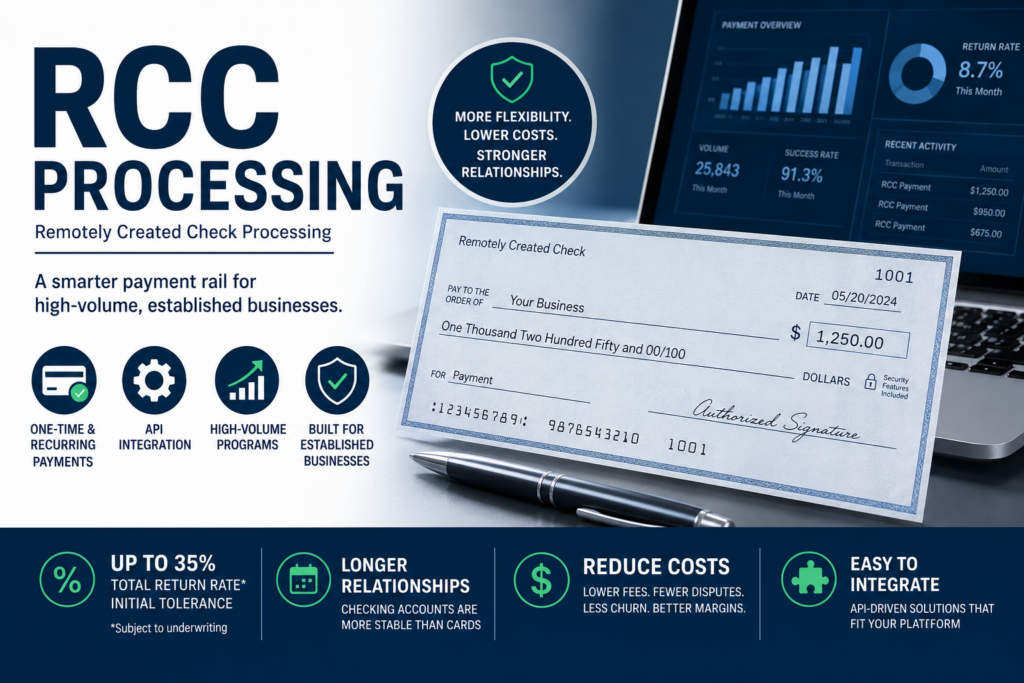
Add Another Payment Rail Without Relying Exclusively on Credit Cards or ACH
Rising card costs, disputes, pre-dispute alerts, restrictive ACH underwriting and changing risk programs can dramatically increase the true cost of accepting payments.
Remotely Created Check (RCC) processing gives qualified, established businesses another way to accept authorized payments from customers’ checking accounts.
Support one-time and recurring payments, integrate through an API, and reduce your dependence on payment methods that may no longer fit your business model.
One-Time Payments • Recurring Payments • API Integration • High-Volume Programs
Your Card Rate Isn’t Your Real Payment Cost
A merchant may start with a credit card processing rate of 3% or 4%.
That number can quickly become irrelevant when you add the full cost of accepting cards:
- Chargebacks
- Dispute fees
- RDR refunds and associated costs
- Ethoca and other pre-dispute alerts
- Refunds issued to prevent disputes
- Visa VAMP exposure
- Fraud monitoring
- Declined recurring transactions
- Reserves and withheld funds
- Lost revenue from disputed transactions
- Internal staff required to manage disputes
For some businesses, payment costs extend far beyond the advertised processing rate.
If your internal numbers show that a 3% or 4% card rate has become an effective payment cost of 10%, 20% or more after disputes, alerts, refunds and other losses, the headline processing rate is no longer the number that matters.
The question becomes: is there a better payment rail for part of your volume?
That is where RCC processing may make sense.
When Traditional ACH Doesn’t Fit
ACH is an excellent payment method for many businesses.
It does not fit every legitimate payment profile.
Banks, ACH processors and sponsoring financial institutions establish underwriting standards based on factors such as:
- Return rates
- NSF activity
- Unauthorized returns
- Industry
- Customer acquisition methods
- Transaction volume
- Average transaction size
- Recurring billing practices
- Merchant history
A business can have real customers, legitimate products, strong fulfillment and years of operating history and still fall outside a particular ACH provider’s risk parameters.
That doesn’t automatically make the business fraudulent or illegitimate.
It may simply mean the merchant needs another payment option.
RCC processing provides qualified businesses with a check-based alternative that does not clear through the ACH Network.
More Flexibility for Higher Return Profiles
One of the biggest challenges with traditional ACH processing is that processors, ODFIs and sponsoring financial institutions may impose strict internal limits on return activity.
These requirements can make ACH difficult for otherwise established businesses with legitimate customers but higher-than-average NSF or overall return rates.
Depending on underwriting and the merchant’s payment profile, our RCC programs can initially accommodate total return rates of up to 35%.
That provides significantly more flexibility for certain qualified businesses whose payment profiles do not fit conventional ACH underwriting.
A higher permitted overall return rate does not mean unauthorized transactions are acceptable.
We still require:
- Valid customer authorization
- Transparent billing practices
- Legitimate products and services
- Clear customer acquisition
- Proper cancellation and refund procedures
- Ongoing monitoring of merchant performance
- Full disclosure of the merchant’s transaction flow
The goal is to accommodate legitimate payment behavior, including NSF and other ordinary returns, without forcing every established business into the same payment-risk profile.
What Is a Remotely Created Check?
A Remotely Created Check, commonly called an RCC, is a check created by the merchant or its authorized processor using checking account information provided by the customer.
Unlike ACH transactions, RCCs are processed through the check-clearing system.
With an approved RCC program, a merchant can create checks from authorized customer banking information and submit those checks for deposit and clearing.
RCC processing can support:
One-Time Payments
Accept an authorized checking account payment for a single purchase or transaction.
Recurring Payments
Support qualified recurring billing programs where customers have properly authorized the merchant to collect scheduled payments.
API Integration
Integrate RCC processing into an existing billing platform, CRM, customer portal or proprietary software.
High-Volume Processing
Build a processing program designed around businesses producing thousands or tens of thousands of authorized transactions each month.
RCC Processing Isn’t About Getting Around the Rules
We are not looking for businesses trying to debit consumers without authorization.
We are not looking for shell companies, deceptive billing operations or merchants attempting to hide how they acquire customers.
We work with established businesses looking for a legitimate additional payment rail.
Every RCC program requires underwriting.
We evaluate factors including:
- Business history
- Products and services
- Customer acquisition
- Authorization procedures
- Billing practices
- Transaction volume
- Return history
- Refund and complaint history
- Websites and marketing materials
- Ownership and banking history
Certain industries, transaction types and customer-acquisition methods may not qualify.
Customer authorization is required.
Who Is RCC Processing For?
RCC processing can be particularly valuable for established businesses with significant one-time or recurring transaction volume.
Potential industries include:
Credit Monitoring Services
Recurring credit monitoring programs can experience card declines, disputes, pre-dispute alerts and processor restrictions as portfolios grow.
RCC can provide qualified credit monitoring businesses with an additional checking-account payment option.
Identity Theft Protection
Identity monitoring and identity protection companies often operate recurring subscription models where payment reliability and processing costs materially affect profitability.
Home Title Monitoring
Home title monitoring and property protection subscription services can use RCC as an additional payment rail for qualified customer billing programs.
Medical Alert & Fall Detection Services
Medical alert, emergency response and fall detection companies frequently operate subscription-based monitoring programs.
Qualified businesses may benefit from adding checking-account payments alongside card processing.
Legal Services
Certain established legal service providers with compliant customer acquisition and authorization procedures may qualify for RCC processing.
Membership & Subscription Businesses
Businesses with large recurring customer bases can use RCC to diversify payment methods and reduce dependence on a single payment network.
High-Volume Direct-to-Consumer Businesses
Established DTC companies with compliant acquisition methods, strong fulfillment and significant transaction volume may qualify after underwriting.
Other High-Volume Businesses
Your company does not need to fall into one of these categories.
If you process significant payment volume and cards or ACH no longer fit the economics of your business, we want to understand your payment flow.
A More Stable Payment Credential for Recurring Billing
Recurring businesses can lose revenue for reasons that have nothing to do with whether the customer actually wants to cancel.
Credit cards expire.
Cards get lost or stolen.
Banks replace compromised cards.
Issuers send customers new card numbers.
Accounts migrate between card products or issuers.
Each credential change creates another opportunity for a recurring payment to decline and another customer whose payment information may need to be updated.
Checking accounts tend to remain in place much longer.
That makes checking-account credentials particularly attractive for businesses built around long-term recurring customer relationships.
Reduce Involuntary Payment Churn
RCC processing can help recurring businesses reduce their dependence on card credentials that may change repeatedly throughout the customer relationship.
For subscription, monitoring and membership businesses, that can mean:
- Fewer payment interruptions caused by expired cards
- Fewer payment interruptions caused by replaced cards
- Less dependence on card-account updater services
- Fewer customers lost because stored payment credentials changed
- More durable recurring payment relationships
- Greater payment-method diversification
Customers still retain their cancellation rights and the ability to revoke authorization according to applicable requirements.
The advantage is payment continuity, not making cancellation difficult.
For businesses whose customers remain enrolled for months or years, checking-account information can provide a considerably more stable recurring payment credential than relying exclusively on cards.
Why Add RCC to Your Payment Strategy?
Reduce Dependence on Credit Cards
You don’t have to move every customer away from cards.
RCC can become another payment option inside a diversified payment strategy.
Reduce Involuntary Churn
Recurring card payments can fail because cards expire, get replaced or change for reasons unrelated to the customer’s relationship with your business.
Checking-account credentials generally offer greater long-term stability.
Avoid Putting All Your Volume on One Rail
Card networks, acquiring banks and ACH processors can change risk requirements.
Multiple payment options reduce concentration risk.
Improve Payment Economics
For the right merchant, RCC pricing can compare favorably with the true all-in cost of credit card acceptance.
Accommodate Higher Overall Return Profiles
Qualified RCC programs can provide more flexibility for legitimate merchants with return profiles that fall outside conventional ACH underwriting.
Support Recurring Revenue
Qualified merchants can build RCC into recurring billing programs where the payment flow and customer authorization meet applicable requirements.
Integrate With Existing Systems
API integration allows high-volume merchants to incorporate RCC processing into existing technology rather than manually rebuilding their billing operation.
Volume-Based Pricing
High-volume merchants can receive custom pricing based on transaction volume, business model and risk profile.
Credit Cards vs. ACH vs. RCC
Credit Cards
Advantages
Fast, familiar and convenient for consumers.
Potential challenges
Processing costs, chargebacks, RDR, Ethoca alerts, VAMP exposure, card expirations, replaced credentials, declines and reserve requirements can materially affect high-volume merchants.
ACH
Advantages
Low transaction costs and excellent economics for businesses that fit conventional ACH underwriting.
Potential challenges
Return-rate requirements and processor-specific underwriting policies can make ACH difficult for certain payment profiles.
RCC
Advantages
Provides a separate check-based payment rail, supports qualified recurring and one-time transactions, can accommodate higher overall return profiles, provides greater credential stability for recurring transactions and can offer attractive economics at scale.
Potential challenges
Requires underwriting, proper customer authorization and a legitimate transaction flow.
The right strategy may involve using more than one payment method rather than forcing every transaction through the same network.
Already Processing RCC?
We also work with established merchants that already have an RCC provider.
If you’re currently processing remotely created checks, we want to understand:
What are you using now?
What’s not working about it?
Maybe you’re dealing with:
- High per-check fees
- Expensive returned-item fees
- Limited integration options
- Poor support
- Slow settlement
- Volume limitations
- Restrictive return limits
- Unpredictable underwriting
- Lack of scalability
Then ask the question that actually matters:
What is the current setup costing your business every month?
A difference of even $0.50 or $1.00 per transaction becomes meaningful when you’re processing 10,000, 50,000 or 100,000 checks per month.
At 50,000 transactions per month, a $1.00 difference in processing cost equals $50,000 per month and $600,000 per year.
Built for Established Businesses
Our RCC program is designed for serious operators.
You may be a strong candidate if you have:
- An established operating history
- A functioning business website
- Clear products and services
- Documented customer authorization
- Consistent transaction volume
- Strong fulfillment practices
- Transparent customer acquisition
- Customer service infrastructure
- A legitimate reason for adding RCC processing
We are especially interested in businesses processing high monthly transaction volumes.
RCC Processing Frequently Asked Questions
What does RCC stand for?
RCC stands for Remotely Created Check.
It is a check created using bank account information provided and authorized by the customer rather than a check physically written and signed by the customer.
Is RCC the same as ACH?
No.
ACH transactions travel through the ACH Network. Remotely Created Checks clear through the check-clearing system.
They are different payment methods with different processing frameworks.
Can RCC be used for recurring payments?
Qualified recurring payment programs can potentially use RCC processing when the merchant’s business model, authorization procedures and transaction flow meet applicable requirements and underwriting standards.
Why can RCC be attractive for recurring billing?
Checking-account credentials tend to be more stable than card credentials.
Cards expire, get lost, get compromised and get replaced. Those events can interrupt recurring card billing even when the customer still wants the service.
For qualified recurring businesses, RCC can provide another way to maintain payment continuity while reducing dependence on frequently changing card credentials.
Can RCC processing integrate with our software?
Yes.
API integration can support merchants that want RCC processing incorporated into an existing billing platform, CRM, customer management system or proprietary technology.
Do you offer RCC processing for high-volume businesses?
Yes.
High-volume established businesses are our primary focus.
Pricing and program structure depend on monthly transaction volume, average transaction size, industry, return history and overall risk profile.
What return rates can your RCC program support?
Depending on underwriting and the merchant’s overall payment profile, qualified programs can initially accommodate total return rates of up to 35%.
Return tolerance does not eliminate authorization, compliance or underwriting requirements.
Unauthorized transactions, deceptive billing and fraudulent activity are not acceptable.
What industries do you accept?
We evaluate merchants individually.
Potential industries include credit monitoring, identity theft protection, home title monitoring, medical alert services, subscription businesses, membership programs, certain legal services and other established high-volume businesses.
Approval depends on the complete business and transaction flow, not simply the industry name.
Can RCC help if our ACH processor has strict return requirements?
Potentially.
Some legitimate businesses fall outside the internal underwriting requirements of particular ACH processors or sponsor banks.
Because RCC is a different payment rail, it may provide another option for a qualified merchant.
Can RCC reduce our credit card processing costs?
Potentially.
The correct comparison isn’t simply the RCC fee versus your advertised credit card rate.
Calculate your total card acceptance cost including processing fees, disputes, chargebacks, pre-dispute alerts, refunds, fraud losses, reserves, failed recurring payments and internal dispute-management costs.
For some high-volume merchants, adding RCC can materially change that equation.
Do you accept every merchant?
No.
RCC processing requires underwriting.
Businesses with deceptive practices, unauthorized billing, fraudulent activity or transaction flows that violate applicable requirements will not qualify.
Find Out If RCC Makes Sense for Your Business
If rising card costs, ACH restrictions, return-rate limitations or payment concentration are hurting your margins, let’s look at the numbers.
Tell us:
- What you’re using today
- Your monthly transaction volume
- Your average transaction amount
- Your current processing cost
- Your return history
- Your current card dispute and alert costs
- What’s not working with your current payment setup
We’ll determine whether RCC processing makes sense for your business and provide pricing based on your volume and payment profile.
Add Another Payment Rail to Your Business
BUTTON: Get an RCC Process
For established, qualified businesses only.
One-Time Payments • Recurring Payments • API Integration • Higher Return Tolerance • Custom Volume Pricing