

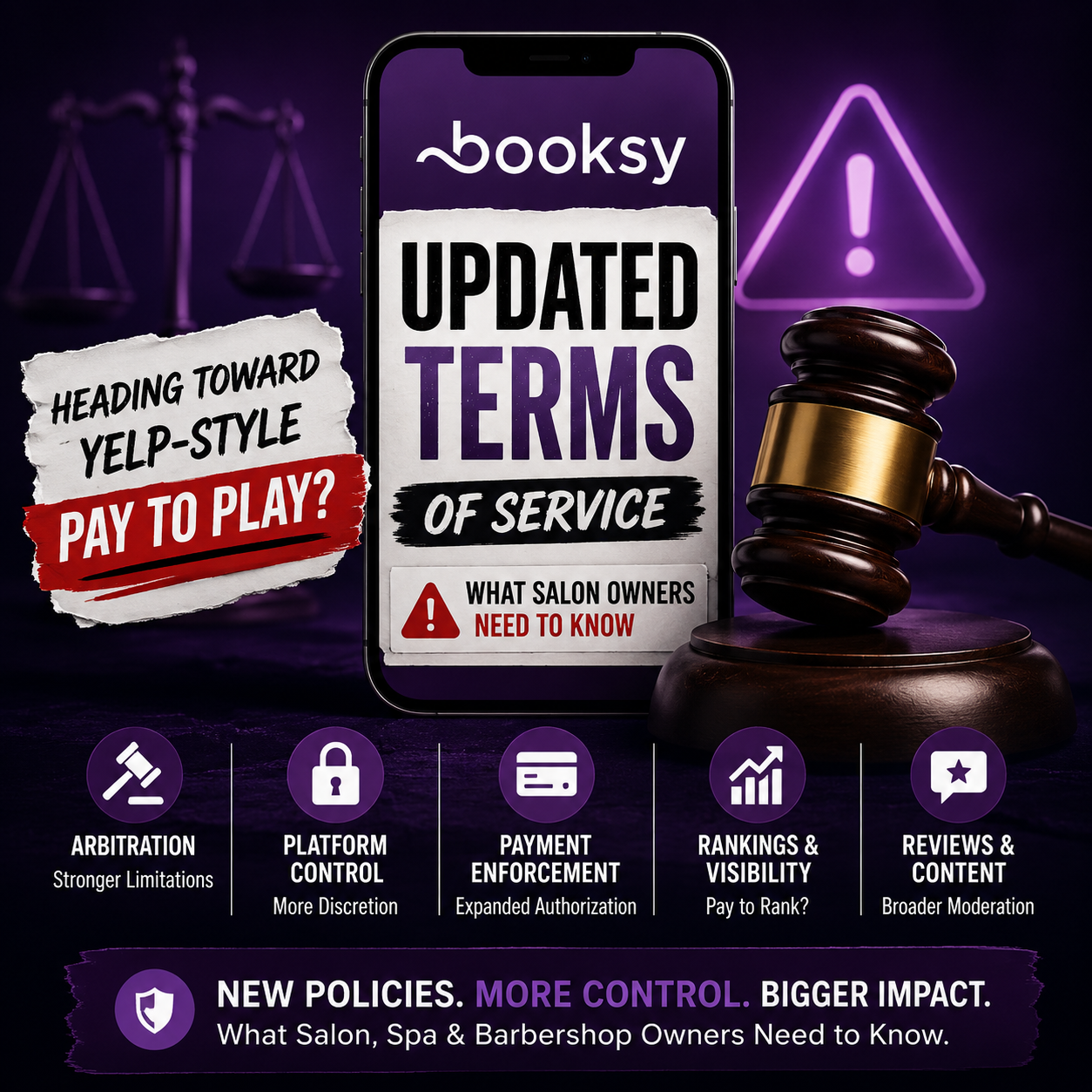
Booksy Updated Their Terms of Service: The Good, the Bad, and the Ugly
If you use Booksy to run your salon, spa, barbershop, or wellness business, you may have recently received an updated Terms of Service email.
Most people probably ignored it.
That’s a mistake.
Buried inside the updated terms are major changes involving:
- cancellation fees
- customer disputes
- arbitration rights
- search rankings
- reviews
- payment processing
- platform control
Some of these changes are understandable from a business perspective.
Others should concern any merchant who depends heavily on a third-party platform for bookings and customer acquisition.
We spent time reviewing the updated agreement carefully, and here’s what stood out.
First: Why This Took Extra Work to Analyze
One thing immediately stood out when reviewing the update email.
The link directed users to a webpage where much of the legal wording appeared in a format that was difficult to highlight, copy, or transfer into analysis tools. Large portions of the Terms appeared embedded as image-based content rather than easily selectable text.
That created friction for anyone trying to carefully review the agreement.
Instead of simply copying the updated Terms into an AI or legal review tool, we first had to:
- convert the document into PDF format,
- run OCR (optical character recognition) in Adobe,
- convert the image-based text into searchable text,
- and then analyze the updated language using AI-assisted contract review.
That process matters because most business owners are busy.
Very few salon owners have time to manually review dozens of pages of legal language line by line.
So we did it ourselves.
And what we found tells a much bigger story about where software platforms are heading.
What Booksy Said vs. What Changed
The update email framed the new Terms of Service as mostly organizational and customer-focused improvements.
Here’s part of how Booksy summarized the update:
“Improved Layout: We’ve reorganized the document into a more logical flow, making it much easier to navigate and find specific sections and definitions.”
“Dispute Resolution: We have updated our provisions regarding arbitration.”
“Refined Content & Review Guidelines: We’ve clarified the rules for posting content, including a new 30-day window to submit or edit your reviews.”
On the surface, that sounds relatively minor.
But after converting the document into searchable text and reviewing the actual legal language, the practical impact appears much broader than the email summary suggests.
For example:
- the arbitration section now contains significantly stronger limitations around class actions and consolidated claims,
- the terms reinforce Booksy’s authority over rankings, moderation, and account control,
- the review language gives the platform broader moderation discretion,
- and the updated payment language expands authorization and cancellation fee enforcement.
In other words:
the update was not simply a formatting cleanup.
It was a meaningful legal and operational restructuring designed to:
- strengthen platform protections,
- reduce liability exposure,
- and expand operational flexibility.
That doesn’t automatically make the changes “bad.”
But it does mean merchants should read beyond the marketing summary before clicking “accept.”
The Good
Better Protection Against No-Shows
One area where Booksy clearly strengthened its platform is payment enforcement.
The updated terms reinforce their ability to:
- collect deposits,
- pre-authorize cards,
- enforce cancellation fees,
- and charge no-show penalties.
For salons and barbers dealing with constant late cancellations, this is objectively useful.
No-shows cost businesses real money.
From a merchant perspective, stronger payment enforcement can absolutely help stabilize revenue.
More Transparency Around Rankings
Booksy also openly explains several factors that affect search rankings inside the platform, including:
- availability,
- ratings,
- completed visits,
- profile engagement,
- promotions,
- and optional paid services.
Most platforms manipulate rankings quietly.
At least Booksy now acknowledges that ranking visibility is influenced by multiple business and monetization factors.
That level of transparency is better than pretending rankings are purely “organic.”
The Bad
You Don’t Fully Control the Customer Relationship
Throughout the updated agreement, Booksy repeatedly positions itself as a marketplace platform rather than the actual service provider.
That distinction matters.
The updated language gives Booksy broad authority to:
- modify policies,
- suspend accounts,
- change platform functionality,
- remove content,
- and limit liability.
At the same time, responsibility for many disputes shifts directly to the merchant.
This is standard behavior for large software marketplaces.
But it creates a serious business risk if your company becomes too dependent on one ecosystem for:
- bookings,
- customer communication,
- reviews,
- or discovery.
The more dependent you become on a platform, the more exposed you are when:
- pricing changes,
- rankings change,
- advertising becomes more important,
- or platform rules evolve.
That should concern every business owner.
Arbitration and Class Action Waivers
The updated terms also include strong arbitration language and class action waivers.
In plain English:
if a serious dispute happens, your legal options become significantly more limited.
The agreement pushes disputes into private arbitration and restricts users from participating in class action lawsuits.
This has become common in large technology platforms, but many users still click “accept” without realizing what rights they’re giving up.
The Ugly
The Yelp Comparison Is Becoming Harder to Ignore
This is where things start looking familiar to many merchants.
The updated terms specifically state that businesses purchasing optional services may appear higher in search results.
That immediately reminds many business owners of Yelp.
For years, Yelp has faced criticism from merchants who believed the platform became increasingly pay-to-play, where visibility and lead flow appeared tied to advertising spend.
Whether every criticism of Yelp is fair or not is beside the point.
Perception matters.
And once merchants begin feeling like visibility depends more on monetization than merit, trust starts eroding quickly.
To be fair:
every software company has the right to monetize its platform.
But there’s a meaningful difference between:
- offering advertising tools,
and - creating an ecosystem where businesses feel pressured to pay simply to maintain visibility.
That distinction matters.
A lot.
The Real Risk Isn’t Booksy
The real issue is platform dependency.
This doesn’t only apply to Booksy.
It applies to:
- Yelp,
- Uber,
- DoorDash,
- Amazon,
- Instagram,
- TikTok,
- and nearly every platform that controls customer access through algorithms.
The moment a third party controls:
- your visibility,
- your bookings,
- your reviews,
- your customer communication,
- or your discovery traffic,
…your business becomes vulnerable to someone else’s rules.
That’s dangerous.
Because those rules can change overnight.
What Smart Salon Owners Are Doing Now
The smartest operators are reducing platform dependency by:
- building direct customer databases,
- improving SMS and email marketing,
- strengthening retention systems,
- automating missed-call recovery,
- using AI-driven communication tools,
- and creating stronger direct relationships with customers.
Platforms should support your business.
They should not become your business.
Looking for Alternatives?
A quiet shift is happening in the salon and wellness software space. More owners are stepping back from marketplace-dependent platforms and asking a sharper question: who actually owns the customer relationship — me, or the software I pay for?
It’s a fair question. When discovery, bookings, and rebooking all flow through someone else’s marketplace, the business owner becomes a tenant on their own customer base. And as more platforms move toward paid-visibility ecosystems, that tenancy gets more expensive every quarter.
One company we’ve been watching closely in this space is DINGG.ai. Their thesis is refreshingly direct: salons and spas should own their growth engine, not rent it.
What that looks like in practice:
- AI-powered booking and customer conversations that run on your brand, not a marketplace listing
- AI-driven discovery and online presence — so customers find your business directly
- Automated, on-brand responses to Google reviews
- Text-based rebook reminders that bring clients back without a middleman
- A clear line between your customer data and anyone else’s platform
We’ve recently partnered with DINGG.ai to provide software and payment processing for salons, spas, barbershops, and wellness businesses — and the reason we said yes is the same reason this matters to our merchants: the model is built around the owner, not the platform.
Payment flexibility that respects how you run your business
Most platforms lock you into one rigid processing structure. We took a different approach with DINGG.ai, supporting:
- Standard flat-rate processing
- Interchange-plus (IC+) pricing
- Surcharging
- Dual pricing
That means depending on your business model and local regulations, you can choose to absorb processing costs the traditional way, pass along credit card fees while absorbing debit, or offset most processing expenses through a dual pricing program. For a lot of businesses, that translates into meaningful savings — without giving up control of the customer experience.
The bigger picture
The headline isn’t really payments or AI. It’s ownership. The platforms winning the next five years in this industry will be the ones that hand the customer relationship back to the merchant — not the ones that monetize visibility to it.
That’s the direction DINGG.ai is heading, and it’s why we’re excited to be working alongside them.
Interested in Learning More?
If you’d like to learn more about Dingg.ai, payment processing options, or reducing dependency on marketplace booking platforms, book a call here:
We’re happy to walk through:
- software options,
- pricing models,
- AI communication tools,
- customer retention strategies,
- and ways to build a more independent business outside of algorithm-driven marketplaces.
Final Thoughts
Booksy is not alone.
This is the broader direction of modern software platforms:
- more monetization,
- more legal protection,
- more algorithmic control,
- and more merchant dependency.
The goal is not to avoid software platforms entirely.
The goal is to avoid becoming trapped by them.
The businesses that understand that early will have a major advantage over the next few years.