

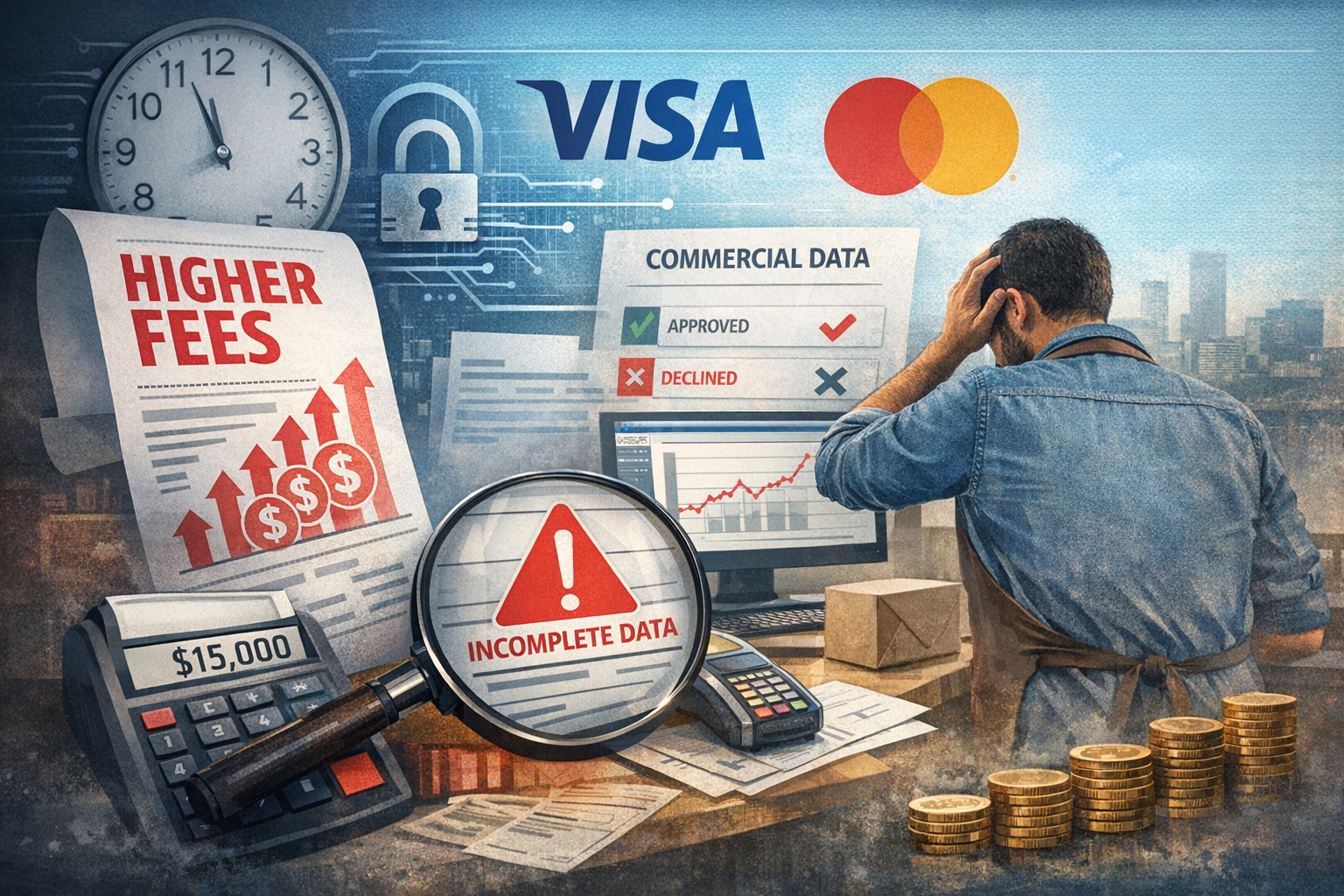
Visa Is Done With Auto-Populated Data
Visa is phasing out auto-populated transaction data and replacing it with stricter, verified requirements. For years, gateways filled in enhanced fields automatically, creating data that looked complete but often had no connection to real cardholder behavior. Visa tolerated it until it started distorting risk and pricing.
Now transaction data is actively evaluated for accuracy and plausibility using automated verification. Merchants who pass clean, defensible data are rewarded with lower processing costs. Merchants who submit low-quality or fabricated data are penalized with higher fees.
The incentive is simple. Accurate data costs less. Garbage data costs more.
Who This Affects and Why You’re Seeing It Without Warning
This change does not impact every merchant evenly. It concentrates around specific card types and payment patterns, which is why many businesses do not notice it immediately.
You are most likely affected if you accept:
- Commercial or purchasing cards
- Government or municipal cards
- B2B payments tied to invoices or customer references
- Large recurring payments from the same vendors or customers
- High-dollar transactions that settle after fulfillment
In these cases, the transaction still approves normally. Nothing breaks at checkout. The impact shows up after settlement, when Visa evaluates the quality of the data tied to the transaction and prices it accordingly.
That delay is why the increase feels sudden. Volume stays flat. Customers stay the same. Fees quietly rise on a subset of transactions that now price higher due to data quality.
If you accept commercial or government cards and no one has reviewed your data handling since last fall, this change is already reflected in your statements.
Why Visa Changed the Rules and What It Costs When Data Fails
Visa and Mastercard originally offered interchange discounts to encourage merchants to share better transaction data. The idea was simple. If card brands received clearer signals about who was buying, what was being purchased, and how transactions behaved, fraud risk would drop and costs could follow.
Gateways responded by auto-populating enhanced data fields to help merchants capture the savings. In practice, this meant merchants saw 0.5% to 1% lower costs without changing how they operated.
That shortcut broke the system.
Auto-population produced uniform, low-signal data that looked complete but did not reflect real cardholder behavior. Identical values appeared across unrelated transactions, and data patterns stopped providing meaningful insight. The discount remained in place, but the card brands received nothing of value in return.
Visa’s response was structural, not symbolic. The Commercial Enhanced Data Program program shifted the model from data presence to data quality. Transaction data is now verified and evaluated for accuracy, consistency, and plausibility. Merchants who submit real, defensible data are rewarded with lower costs because their transactions present less risk.
Poor data now prices higher automatically. There is no manual review and no warning. Transactions that fail verification simply clear at higher interchange.
That is why merchants often pay for months before realizing what changed. The checkout still works. The customer still pays. The only difference is buried in settlement, where low-quality data quietly becomes more expensive.
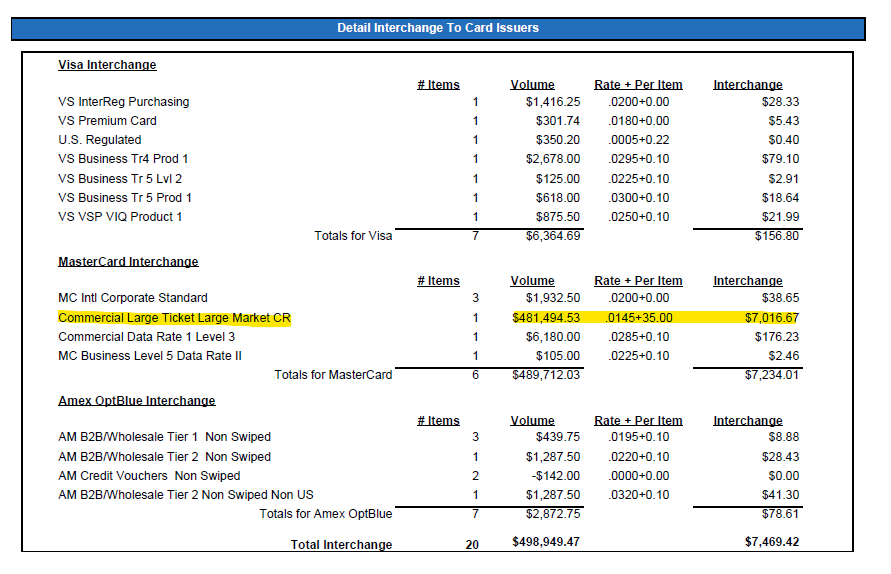
Example: Large-Ticket Commercial Interchange Qualification
In the example above, a purchasing card transaction batch includes $481,494.52 in volume that qualified for the Commercial Large Ticket interchange category at 1.45% + $0.35 per item.
Large-ticket commercial categories exist specifically to reduce interchange on high-value B2B transactions.
If that same volume had processed at a typical ~3% corporate card rate, the cost would have been approximately:
$481,494.52 × 3% = $14,444.84
Instead, the qualified rate produced:
$481,494.52 × 1.45% = $6,981.67
- per-item fee ≈ $35
Total cost: about $7,016
Estimated Savings
Approximate savings on this batch:
$14,444 − $7,016 = $7,428 saved
That represents roughly a 51% reduction in interchange cost for that volume.
This is why enhanced data qualification matters for merchants processing commercial, purchasing, or government cards.
The Timeline: How Costs Quietly Increased After November
The Commercial Enhanced Data Program changes began taking effect in November, but most merchants did not feel the impact immediately.
Transactions continued to approve normally. Gateways continued passing data the same way they always had. The difference happened after settlement, when transactions began pricing based on verified data quality instead of assumed compliance.
For many merchants, this showed up on only a portion of volume. A specific purchasing card. A government customer. A recurring vendor payment. The rate on those transactions quietly moved from something like 1.45% to 2.7%.
On paper, that looks small. In reality, it compounds fast.
If you process $2 million per month from a single commercial customer or vendor, that shift adds roughly $15,000 per month in additional fees. Over a few months, that turns into tens of thousands of dollars paid without a clear explanation.
Nothing broke. No alert fired. No one called you.
Visa simply stopped honoring discounts tied to low-quality data and repriced the risk automatically. Merchants who did not review their interchange detail often discovered this only after comparing statements months apart.
By the time most businesses noticed, the higher pricing was already normalized.
Why Opting Out Can Be Smarter Than Passing Bad Data
Once a merchant submits enhanced commercial data, Visa evaluates its quality automatically. If the data fails verification, the transaction prices higher. That makes partial or low-quality participation more expensive than not participating at all.
This is where many merchants get trapped.
They are not doing anything malicious. Their gateway auto-populates fields. Their processor left the feature turned on. Data flows through because it always has. The problem is that inaccurate or generic data now signals higher risk, even when the underlying transaction is stable.
In those cases, opting out of enhanced data is often the correct financial decision. Submitting no data avoids the penalty tied to poor data quality and prevents silent reclassification. It stops the bleeding while a proper data strategy is put in place.
Merchants who benefit from the program do so intentionally. They know which transactions qualify, they verify what gets submitted, and they only participate when the data is accurate. Everyone else pays extra for the illusion of compliance.
The program no longer rewards effort. It rewards correctness.
Why No One Reached Out When Your Costs Went Up
Most merchants assume someone would call if fees increased materially. That assumption does not survive contact with how processing is sold and managed.
CEPD now requires real decisions and real work. Someone has to decide whether a merchant should opt in or opt out. If opting in, someone then has to ensure accurate data is added after the transaction. Auto-population is no longer acceptable, which eliminates the old “set it and forget it” model entirely.
That leaves two practical options. Customers can be asked to enter additional data at checkout, which rarely happens, or the gateway can flag qualifying transactions so the merchant can return later and add verified data. The second option is the only approach that works at scale, but most providers do not offer it.
This gap is exactly why Ethical Pay Pro offers a gateway that flags CEPD-eligible transactions and allows merchants to add accurate data after the transaction, without risking penalties from auto-generated fields.
When no one owns the decision or the process, fees rise quietly. Tools and accountability are the only way to stop that.
How to Stop Overpaying and Decide What Comes Next
If your processing costs increased since November and no one gave you a clear explanation, CEPD is almost certainly involved. The good news is this is fixable, but only if someone actually reviews how your transactions are being classified.
That review starts with identifying which transactions are affected, whether enhanced data is being submitted, and whether that data is helping or hurting pricing. From there, the decision becomes straightforward. Either opt out where data quality cannot be supported, or participate intentionally with a process that preserves the discount.
This is where many merchants realize the larger issue. If your provider did not flag the change, did not explain the risk, and did not offer a way to control participation, they are not managing your cost structure. They are simply moving transactions.
Ethical Pay Pro works with merchants to:
- Review interchange changes tied to CEPD
- Identify where costs increased and why
- Decide when opting out makes more sense
- Implement flagged workflows where quality data is worth submitting
If you are paying more because no one was watching, it is time to change that.
👉 Visit the contact page to schedule a review and find out where the extra fees are coming from and how to stop them.
Waiting does not make this cheaper. It just makes it permanent.