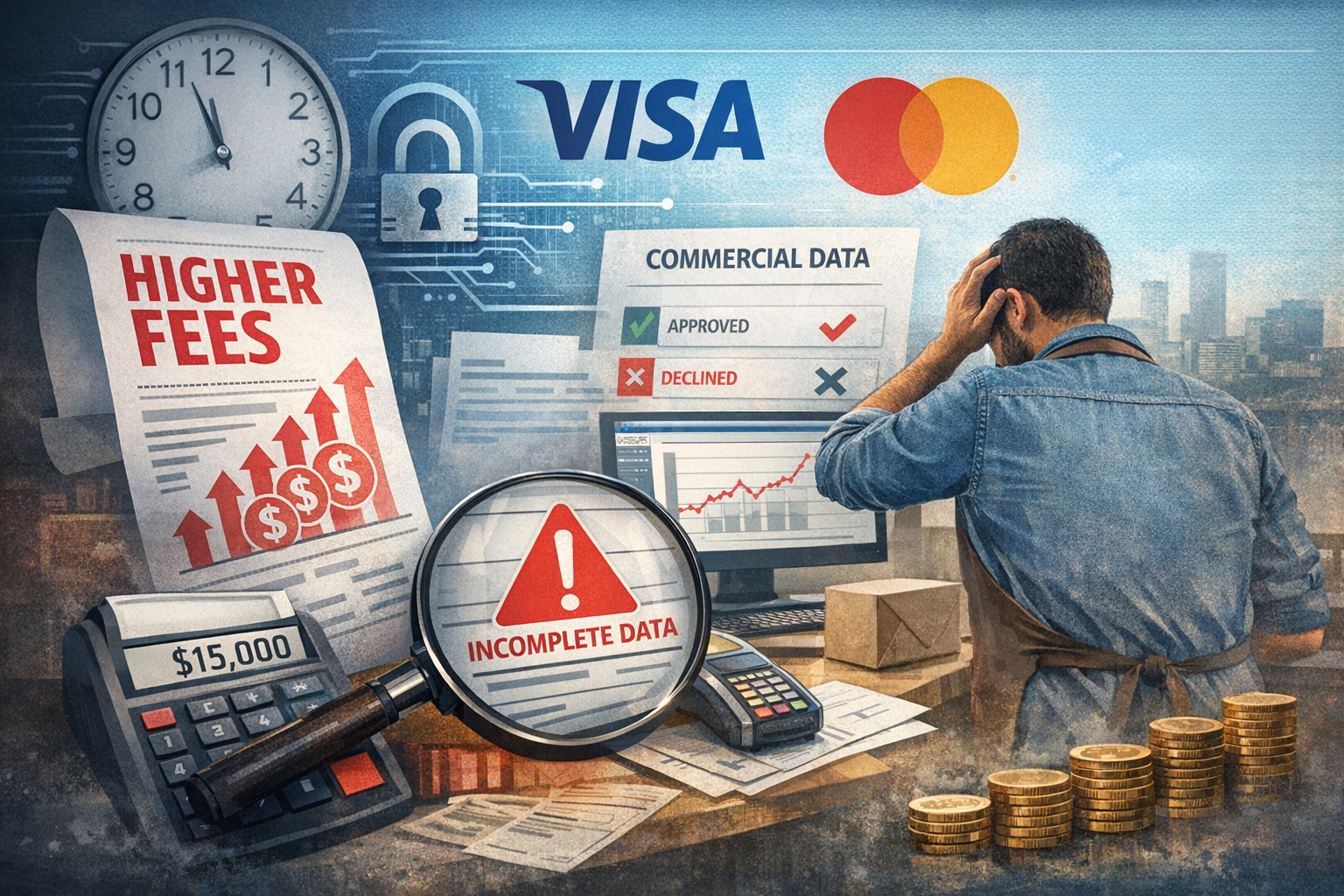

Illinois lawmakers attempted to address a common frustration among merchants: paying credit card processing fees on money they never keep.
Service businesses such as restaurants, salons, and barbershops often process large volumes of tips through their payment systems. Those tips ultimately go to employees, not the business. Yet the merchant still pays processing fees on the full transaction amount.
Consider a restaurant with ten employees who each earn about $60,000 per year in tips. That business processes roughly $600,000 in gratuities annually. At a 3% processing cost, the restaurant pays about $18,000 per year in fees on tips alone.
From a business owner’s perspective, the complaint is straightforward: why pay card fees on money that belongs to someone else?
The Illinois Interchange Fee Prohibition Act (IFPA) was designed to address this issue by prohibiting interchange fees on the tax and gratuity portion of a transaction.
What the Law Is Trying to Do
A typical transaction might look like this:
| Component | Amount |
|---|---|
| Service | $100 |
| Sales Tax | $7 |
| Tip | $20 |
| Total Charged to Card | $127 |
Under the Illinois rule, interchange fees would apply only to the $100 service amount. The $27 representing tax and gratuity would be excluded.
The concept appears simple. If the merchant never keeps the tax or the tip, lawmakers argue that the merchant should not pay interchange on those portions of the transaction.
However, removing a fee does not remove the underlying cost of processing a payment. The payment networks, issuing banks, and processors still incur expenses to authorize, route, settle, and secure the transaction.
If merchants do not pay those costs through interchange, the fees will likely reappear elsewhere in the pricing structure.
Someone in the system must still cover the cost of processing the payment.
Why the Law May Not Reduce Merchant Costs
Many small businesses operate on flat-rate pricing. A common structure is 2.9% plus $0.30 per transaction, regardless of the underlying interchange category.
For these merchants, removing interchange from tips and taxes won’t lower the total cost at all. The processor can still charge the same flat rate on the full transaction amount.
As a result, a large portion of merchants may see little or no savings even if the law is implemented.
How Merchants Currently Offset Card Fees
Merchants typically rely on two structures to offset processing costs: surcharging and cash discount programs.
Surcharging
A surcharge adds a fee to credit card transactions to offset processing costs. Card network rules require merchants to disclose the surcharge at entry and at checkout, cap the fee at 3%, and apply it only to credit cards. Debit cards cannot be surcharged.
Cash Discounting
Cash discount programs take the opposite approach. The merchant raises the advertised price to reflect the card price and then offers a discount to customers who pay with cash.
Example:
| Price Type | Amount |
|---|---|
| Advertised Card Price | $103 |
| Cash Discount | -$3 |
| Cash Price | $100 |
This structure complies with network rules because the posted price is technically the card price.
However, it creates practical challenges. Businesses that prefer clean marketing prices such as $99 or $100 often must raise their advertised price to something like $102.97 or $103.00. Restaurants and salons may need to reprint menus, update signage, and revise marketing materials.
Why Visa Rules Prevent Passing 100% of Fees
Even with surcharging or cash discounting, merchants often cannot pass along their full cost of card acceptance.
Two major limitations create this problem.
When surcharging, a fee cannot be added to debit cards. When a customer pays with debit, the merchant must absorb the processing cost.
Tips create additional complications for surcharging and cash discounting.
In many restaurants and service businesses, the card is first authorized for the base amount. The customer writes a tip on the receipt, and the merchant adjusts the transaction later during settlement.
Because the tip is added after the authorization, a surcharge cannot be applied to that portion of the transaction. The merchant ends up absorbing the processing cost on the gratuity.
And when cash discounting, even when tips are entered directly on mobile payment terminals, applying fees to gratuities raises compliance issues under card network rules.
The result is that merchants rarely recover 100% of their card processing costs unless they choose to break card brand rules.
Typical surcharge programs compensate by charging the merchant an additional 1% blended fee while passing a 3% surcharge to customers. That extra margin covers debit transactions and other costs the merchant cannot legally pass through.
What Some Merchants Do Instead
Because the rules around surcharging and tip adjustments can be complicated, some merchants bypass the typical tip adjustment workflow.
A transaction may work like this: The bill is $50 The customer says to add a $10 tip The merchant enters $60 total and 4% fee is added to cover processing costs.
The fee is now calculated on the full $60 transaction, including the tip.
While this approach is sometimes used in practice, it often violates card network rules. Surcharges are capped at 3%, must be clearly disclosed, and cannot be applied to debit card transactions. Visa and other card brands can impose escalating penalties for non-compliant surcharging programs.
These typically begin with warning letters and may escalate to initial fines of $1000-$5000, doubling over time and potentially reaching $50,000 after six months if violations are not corrected.
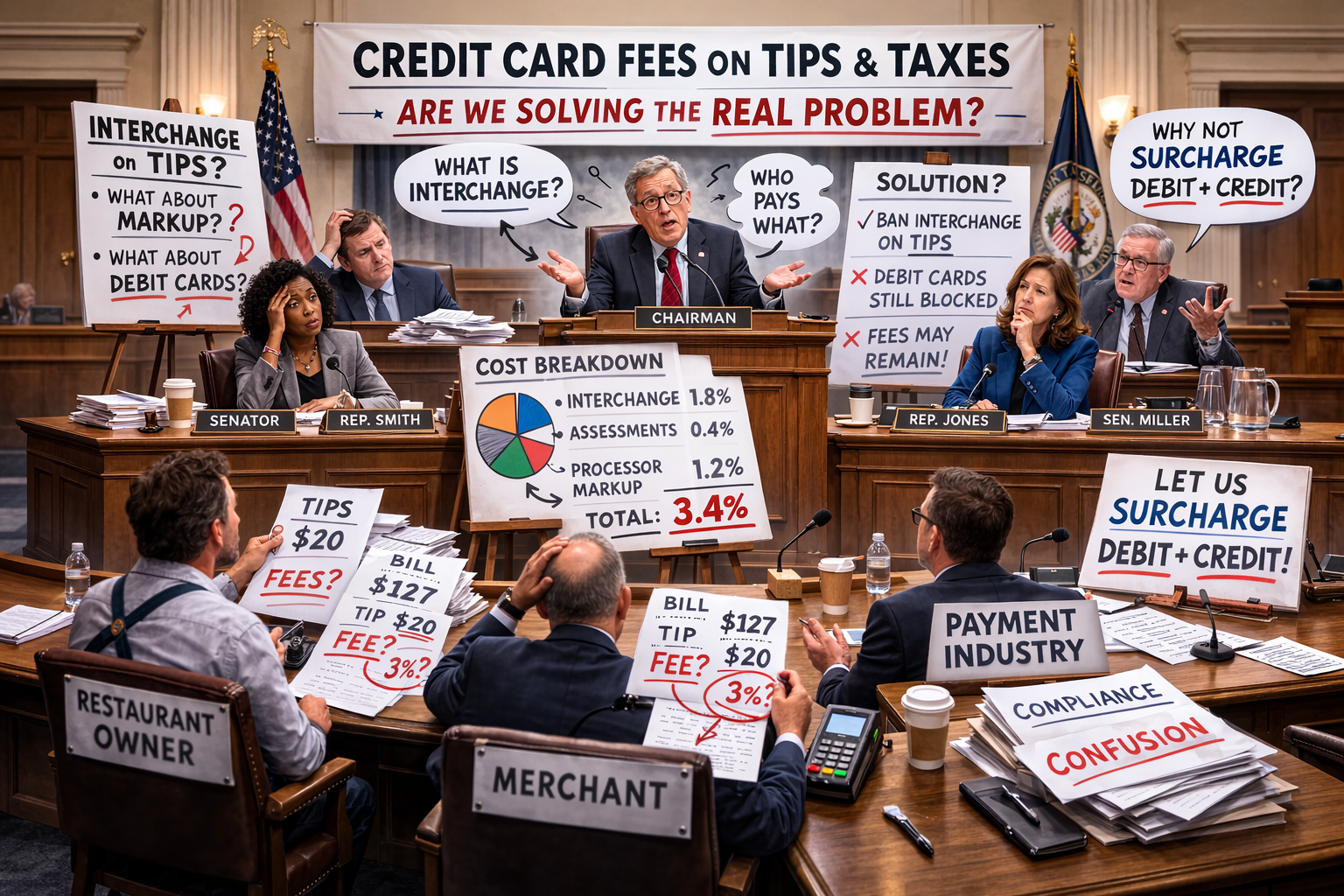
The Structural Problem Lawmakers Are Missing
The Illinois law focuses on eliminating interchange fees on tips and taxes.
But interchange represents only one part of the payment cost structure. Processing costs also include network assessments and processor markup.
More importantly, the system prevents merchants from applying consistent card pricing across all payment types.
Merchants may surcharge credit cards but not debit cards. This forces businesses to absorb debit processing costs and navigate a patchwork of complex pricing rules.
A Simpler Solution
A more straightforward solution would allow merchants to apply transparent card pricing to both credit and debit transactions, with clear disclosure at entry and checkout.
Customers who want to avoid the fee could pay with cash. Customers who prefer the convenience of cards could choose the card price.
This approach would allow the market to determine fair pricing rather than forcing merchants and processors into complex workarounds.
What Happens Next
The Illinois Interchange Fee Prohibition Act is still being litigated and has not fully taken effect. Implementation timelines remain uncertain, though industry discussions have pointed to a potential mid-July rollout if the law survives court challenges.
If implemented, the rule could create operational challenges for payment processors and more complicated reporting for merchants.
At the same time, many businesses on flat-rate pricing may see little reduction in costs because processors will still charge to process the transaction.
Processing costs do not disappear when a specific fee is removed. They simply move somewhere else in the system.
The Illinois law attempts to solve a real merchant frustration. But without addressing the broader structure of card pricing rules, it risks creating complexity without delivering meaningful relief.