

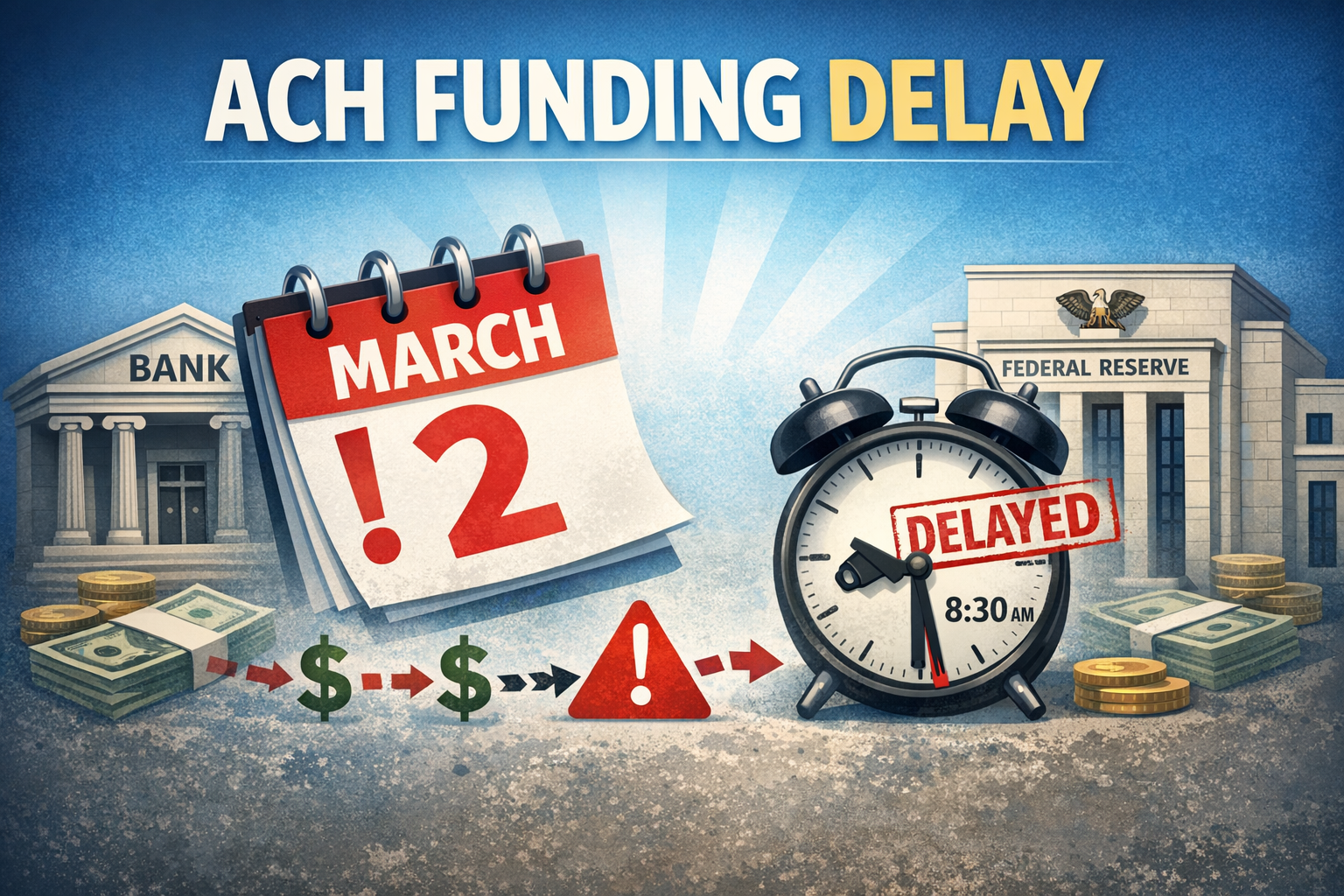
ACH Funding Delay Today: What Happened, Who It Affected, and Why It Matters
If you expected an ACH deposit this morning and it did not show up, you were not alone.
On March 2, the Federal Reserve posted a service alert stating:
“FedACH® Services is delayed with the delivery of the end of day ACH distribution files for the March 2nd business day. Delivery of advices and the 8:30 AM ET scheduled settlement are also delayed. Customers may also experience a delay in receiving acknowledgements for files transmitted for the March 3rd business day while end of day files from March 2nd are still processing. Customers are advised to not resend their FedACH origination files if they are still pending receipt of an acknowledgement.”
The original status page at frbservices.org later returned an error.
By the time you are reading this, your deposit may already have arrived. Reports indicate the disruption lasted roughly 90 minutes. That may not sound like much, but it was enough to impact the morning funding cycle nationwide.
This was not a single processor issue. It affected ACH flows across the United States.
Let’s break down what happened and what it means.
What Was the ACH Delay?
The Federal Reserve’s FedACH service experienced a delay in delivering end-of-day distribution files and the scheduled 8:30 AM ET settlement.
That 8:30 AM settlement window is critical. Many banks rely on it to post:
- Merchant funding deposits
- Payroll credits
- Vendor payments
- Settlement from payment processors
When that window shifts, even briefly, downstream deposits shift with it.
The important takeaway:
This was a Federal Reserve-level processing delay. Not a processor failure. Not a bank liquidity issue.
By mid-afternoon, reports indicated processing appeared normal again.
If you are searching “ACH funding delay tomorrow” or “Is ACH fixed?” the answer is:
Yes. Systems appear to be operating normally. If your morning deposit was delayed, it should post on the next available cycle.
Should You Resend Your ACH File?
No.
The Federal Reserve explicitly instructed customers not to resend FedACH origination files if acknowledgements were pending.
Resending files during a backlog can create:
- Duplicate payment risk
- Reconciliation issues
- Additional processing congestion
If your file was submitted, allow it to clear through the system.
Why Every Processor Was Affected
This is where confusion spreads quickly.
When merchants do not receive funding, they often blame:
- Their payment processor
- Their ISO
- Their acquiring bank
In reality, payment processors do not “hold” or “release” money at will.
Here is how the money actually moves:
- A customer pays your business.
- Your processor batches transactions.
- The acquiring bank submits settlement instructions.
- The Federal Reserve’s ACH network clears and settles funds between banks.
- Your bank credits your account.
The Federal Reserve sits at the center of interbank settlement in the United States. When FedACH experiences a delay, every downstream participant feels it.
Processors facilitate data transmission and coordination. They do not warehouse the funds.
The Transparency Problem
Two issues stood out today.
1. The Status Page Disappeared
The Federal Reserve published an outage notice. Later, the status page returned an error.
Even if the issue was resolved quickly, removing the page created confusion. Merchants searching for confirmation saw nothing.
In a system that moves trillions of dollars, clarity matters.
2. Communication from Processors Was Reactive
Many merchants learned about the delay only after noticing a missing deposit.
In several cases, processors did not proactively notify merchants. Business owners had to:
- Contact their rep
- Compare notes with other merchants
- Search online for confirmation
A 90-minute disruption is operationally small. A 90-minute silence feels much larger.
How Big Was the Impact?
The glitch reportedly lasted about 90 minutes.
That is short in infrastructure terms. It is long in payroll terms.
For businesses operating with tight liquidity:
- Payroll files may depend on same-day settlement
- Vendor wires may depend on incoming ACH credits
- Daily merchant funding may cover operating expenses
When you operate close to zero buffer, even a minor timing shift creates stress.
If You Were Missing an AM Deposit
By now, most delayed settlements appear to have cleared.
If your deposit did not post this morning:
- It should reflect on the next available settlement cycle
- Confirm with your bank before escalating
- Do not resend originations
If tomorrow’s ACH funding is what you are concerned about, there is no indication of ongoing disruption.
The Real Lesson: Liquidity
The Federal Reserve did nothing malicious. Processors did not fail.
This was a system glitch.
But it highlights a reality:
If a 90-minute delay creates anxiety, your business is operating without enough buffer.
Every business in America runs on timing:
- Card settlements
- ACH credits
- Payroll cycles
- Vendor net terms
Infrastructure works extremely well most of the time. When it pauses briefly, cash flow fragility becomes visible.
Strong operators keep:
- Several days of operating expenses liquid
- Access to a standby line of credit
- Contingency planning for settlement delays
Not because the system fails often. Because when it does, it creates opportunity cost.
Do You Have Backup Liquidity?
If your business depends on daily funding to meet obligations, you should have a secondary source of capital that you can draw instantly in an emergency.
Not long-term debt. Not expensive panic financing.
A simple, pre-approved line of credit that sits unused until needed.
With a complete package, funding can be completed within 48 hours. Once established, you draw only when necessary.
If you do not have a few extra days of operating expenses in reserve, this is the moment to fix that.
Set up your safety net before the next delay.
Contact:
https://ethicalpaypro.com/contact
Final Word
Today’s ACH funding delay appears resolved. Deposits should normalize.
If your funds were late this morning, they were not singled out. The issue was national.
If the experience made you uncomfortable, treat it as a signal.
Infrastructure hiccups are rare. Cash flow stress is common.
Build for both.