
Louisiana SB 254 and Credit Card Surcharging: What Merchants Need to Fix Before States Start Fining
Louisiana SB 254 reinforces something that already exists but is widely ignored: you cannot apply fees to debit card transactions, and you cannot disguise surcharges as something else.
Card networks like Visa and Mastercard already set these rules. SB 254 signals that states may start enforcing them directly.
Most merchants are not intentionally breaking rules.
It’s natural to want clean pricing. Nobody wants to advertise $103.27. They want to advertise $99 or $100.
So what do they do?
- Advertise: $99
- Charge at checkout: $103 when a card is used
That feels logical. It feels fair.
But that’s not compliant if the fee is added when a debit card is used.
The cash discount version flips the model:
- Advertise: $103
- Offer a cash discount to $99
That difference matters. One is a properly structured discount. The other is a surcharge added at the point of sale.
Most merchants land in the middle because they’re trying to balance:
- Clean marketing
- Passing debit and credit card fees to customers
That middle ground is exactly where Visa and Mastercard currently loosely enforce. If more states pass a law like Lousiana just did, we’ll likely see more enforcement.
The Real-World Mistake Everyone Is Making
Here is exactly what is happening in the wild:
Example 1: The “$100 bait-and-switch”
- Website price: $100
- Menu board: $100
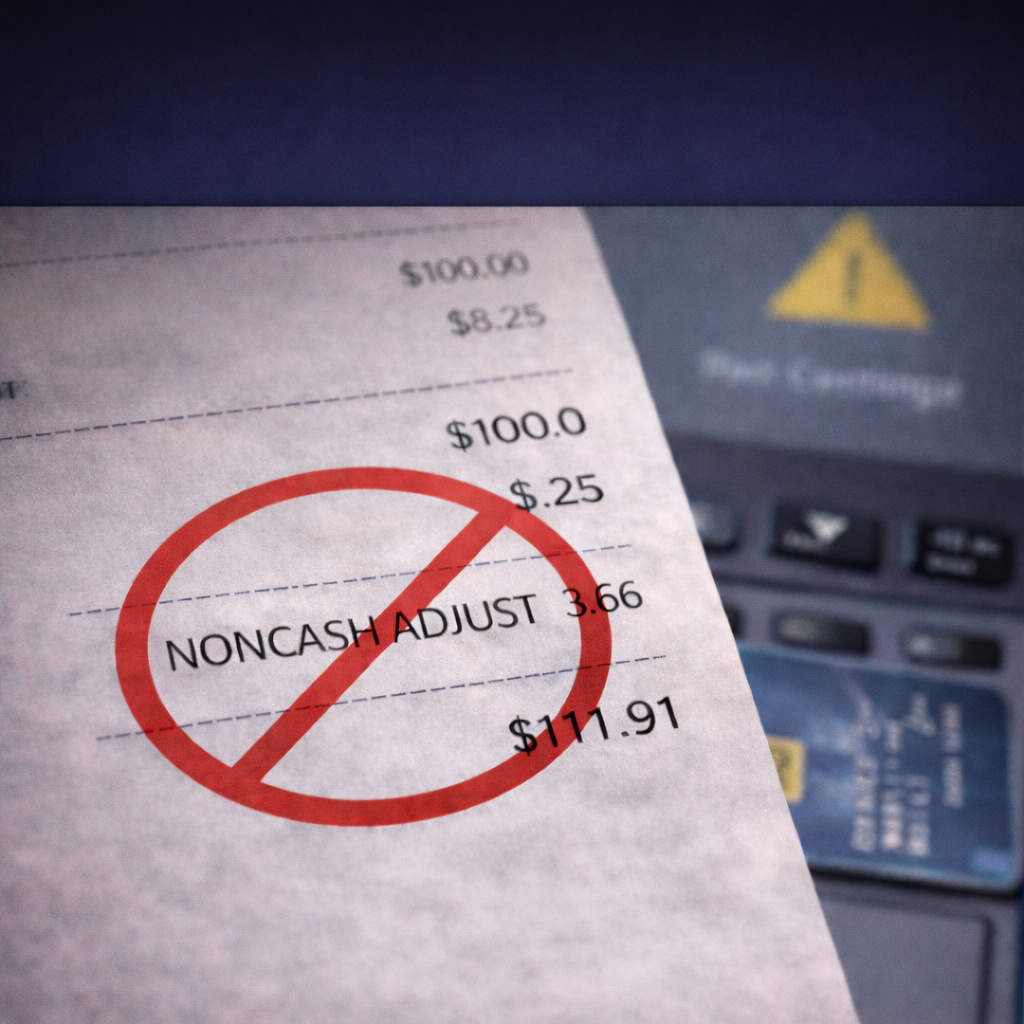
- Customer checks out with a card → total becomes $103
Merchants think:
“That’s just a processing fee”
Reality:
- That is a surcharge
- If applied to a debit card, it is non-compliant
Example 2: Fake “cash discount” model
This is the one almost everyone gets wrong.
What merchants say they are doing:
- “We offer a cash discount”
What they are actually doing:
- Advertise: $100
- At checkout:
- Card = $103
- Cash = $100
That is NOT a cash discount.
That is:
A surcharge disguised as a discount
What a Compliant Cash Discount Actually Looks Like
If you want to do this correctly, the structure flips:
- Advertised price: $103
- Customer pays with card: $103
- Customer pays with cash: $100 (discount applied)
Key rule:
The displayed price must be the highest price (card price)
If you advertise $100 and then increase it at checkout, you are out of compliance.
Where This Gets Dangerous Under SB 254
Before:
- You might get ignored. Compliance is rarely enforced. Visa does have a dedicated page to report merchants who break the rules.
- If caught, you’ll receive either a notice or a 1k fine
- Fines escalate quickly every month. Potential forced refunds to cardholders, merchant account termination, and match listing. Merchants will make the enforced changes before these catastrophic events occur.
With state-level enforcement:
- You can get fined $500 by the state.
- There is no buffer between you and enforcement
- States may see this as a temporary revenue opportunity
Debit Card Landmine (This Will Get You Burned)
Another real-world scenario:
- Merchant adds 3.0% to all card transactions
- Customer uses a debit card
- Fee still applies
This is flat-out non-compliant:
- Card network rules prohibit it
- SB 254 reinforces it
If your card terminal or online gateway cannot distinguish debit vs credit, you are exposed.
The Ugly Truth About Visa Rules
This is where things get frustrating.
Visa’s framework forces a pricing structure that:
- Requires the card price to be the advertised price
- Caps surcharges at the cost of acceptance
- Requires disclosure at point of entry and point of sale
What this creates in practice:
- When a $100 item becomes $103:
- Advertised pricing no longer matches the final charge
- Customers feel bait-and-switched at checkout. Staff has to explain pricing instead of selling
- Small fees create friction at the moment of purchase
So what does a merchant typically do?
They cheat the model:
- Advertise $100
- Add fee later
Which puts them out of compliance;
Why Merchants End Up in the Gray Area
Visa’s rules look clean on paper, but they don’t hold up in a real business.
The real problem:
- Sales agents don’t understand compliance
- Bad processors enable sales agents to oversimplify the setup.
- Merchants prioritize clean, simple pricing over compliance and a safe set up.
So they land in a hybrid model that:
- Looks clean
- Converts better
- Violates rules
What You Should Actually Do
If you want to stay clean and avoid future enforcement risk:
1. Surcharging: If you add a fee at checkout, never apply it to debit or prepaid cards
Only apply surcharges to credit cards, within allowed state limits.
No exceptions. No workarounds.
Cash Discounting: Set your advertised price correctly
- The displayed price must be the card price
- Cash price is presented as the discount
Use systems that enforce compliance automatically
Manual setups lead to mistakes.
Nationwide Support (Location Doesn’t Matter)
We operate out of Florida, but service merchants across the U.S.
Terminal setup:
- Ships pre-configured
- Plug in power
- Connect via Ethernet or Wi-Fi
- You’re live
POS installs:
- Remote configuration available
- On-site support handled via vetted third parties if needed
There is no reason to stay with a non-compliant setup because of geography.
Final Take
Most merchants are not compliant. They just haven’t been forced to care yet.
SB 254 introduces a shift:
- From optional compliance
- To enforceable behavior
If you are:
- Advertising one price
- Charging another at checkout
- Applying fees to debit
You are exposed.
Fix it before enforcement catches up.